What Happens When One Bad Actor Enters the Commons?
We built a simulation platform and a card game to find out. The answer is more disturbing than we expected — and has direct implications for climate negotiations.
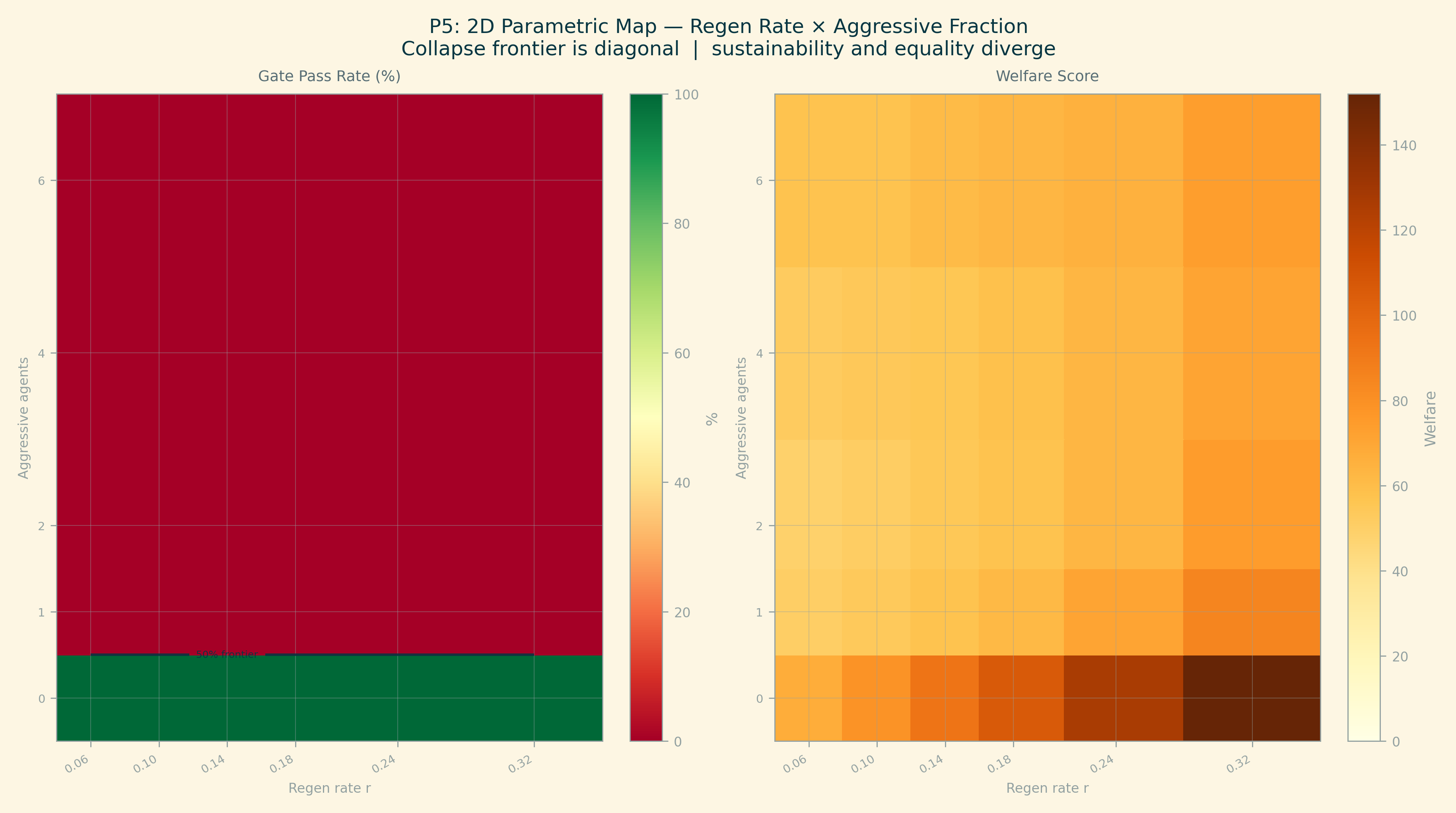
Gate pass rate as a function of regeneration rate and number of aggressive agents in an 8-agent pool. The only green region — the only sustainable outcome — is zero aggressive agents, regardless of how fast the resource regenerates.
Imagine a fishing village. The lake is shared, the fish regenerate every season, and most villagers fish moderately. Then one person arrives with a larger net. How many such people does it take to collapse the fishery?
The intuitive answer is: it depends. On the size of the lake, the regeneration rate, the number of moderate fishers. Surely a single bad actor in a large, healthy commons cannot do that much damage?
Our experiments say otherwise. One is enough — within the canonical regime of realistic common-pool resources (regeneration rates r ≤ 0.32). A single aggressive agent reduces the collective survival rate to zero — not gradually, not probabilistically, but as a sharp, discontinuous transition. The cliff edge is remarkably low: even a minimally extractive aggressor (taking just over 5% of stock per turn, at i ≈ 0.06) suffices to doom the commons.
Why This Question Now
The management of shared resources — forests, fisheries, aquifers, the atmosphere — is one of the oldest and hardest problems in human organisation. Garrett Hardin gave it a name in 1968: the Tragedy of the Commons. His diagnosis was bleak: without private ownership or central control, rational individuals will inevitably over-extract from shared resources until they are exhausted.
Elinor Ostrom won the Nobel Prize in Economics in 2009 by showing that Hardin was wrong — or at least incomplete. Real communities have developed sophisticated institutional arrangements to govern shared resources sustainably for centuries: graduated sanctions, monitoring systems, nested governance structures. The tragedy is not inevitable. It is a failure of institutional design.
"Increases are of sluggish growth, but the way to ruin is rapid." — Seneca, Epistulae ad Lucilium, 91 AD
But both Hardin and Ostrom largely ignore a third dimension: time. Specifically, the asymmetry between how slowly complex systems grow and how quickly they collapse. The Roman philosopher Seneca noticed this pattern two thousand years ago. Modern systems scientists call it the Seneca Effect: resource stocks that took decades to build can be exhausted in years. The collapse, when it comes, arrives faster than any institution can respond.
BDPD — which stands for Be Different Play Differential — is our attempt to study what happens when all three dynamics operate simultaneously: the tragedy of the commons, wealth inequality between agents, and the asymmetric time of the Seneca Effect. We built two instruments to do this.
The Laboratory: Platform and Card Game
The first instrument is a multi-agent simulation platform: a configurable digital environment where artificial agents compete for a shared resource that regenerates logistically (think: a forest that grows back, but more slowly the more it is depleted). The platform is deliberately designed to make the hidden dynamics of real commons visible and measurable. The resource has a hidden reserve — agents never know exactly how much is left. Collapse, when it comes, is irreversible. Agents that accumulate more wealth can harvest more each turn, creating a compounding advantage that mirrors real-world dynamics.
The second instrument is The Forest of Humbaba, a physical card game set in ancient Mesopotamia — the same world as the Epic of Gilgamesh — where players compete for the cedars of a sacred forest guarded by the demigod Humbaba. Each card mechanic is a direct physical translation of a simulation mechanism: the Forest Deck is the commons stock, the hidden Box Reserve captures threshold uncertainty, the Forest Die introduces stochastic collapse, and the Seneca Clip card triggers the irreversible cliff.
Four archetypal player decks embody four strategic archetypes: the Warrior-King (aggressive extraction), the Temple Keeper (conservation and healing), the River Merchant (adaptive response to signals), and the Stranger-King — a cooperative agent who, at some point, betrays everyone.
The card game serves a purpose beyond entertainment: it lets real people experience the same dynamics we measure in the simulation, with their own hands on the cards and their own judgment about when to defect. It also lets us run the same experiments with large language model AI agents, giving us a third substrate to compare.
The Result That Surprised Us Most
The most counterintuitive finding came from the card game, not the simulation. In the simulation, any defection is catastrophic — the cooperative equilibrium collapses completely and immediately. We expected the same in the card game.
We were wrong.
Against the Temple Keeper — the conservative, healing archetype — the Stranger-King can betray, extract aggressively, and accumulate +27% more wealth than if it had cooperated all along. And the forest survives. Not only does defection go unpunished; it goes undetected by the ecosystem itself.
The mechanism is almost painfully simple. The Temple Keeper's healing cards keep the forest healthy. That healthy forest provides exactly the ecological slack the Stranger-King needs to extract without triggering collapse. The cooperator's virtue subsidises the defector's profit. We call this the Tragedy of the Compensator.
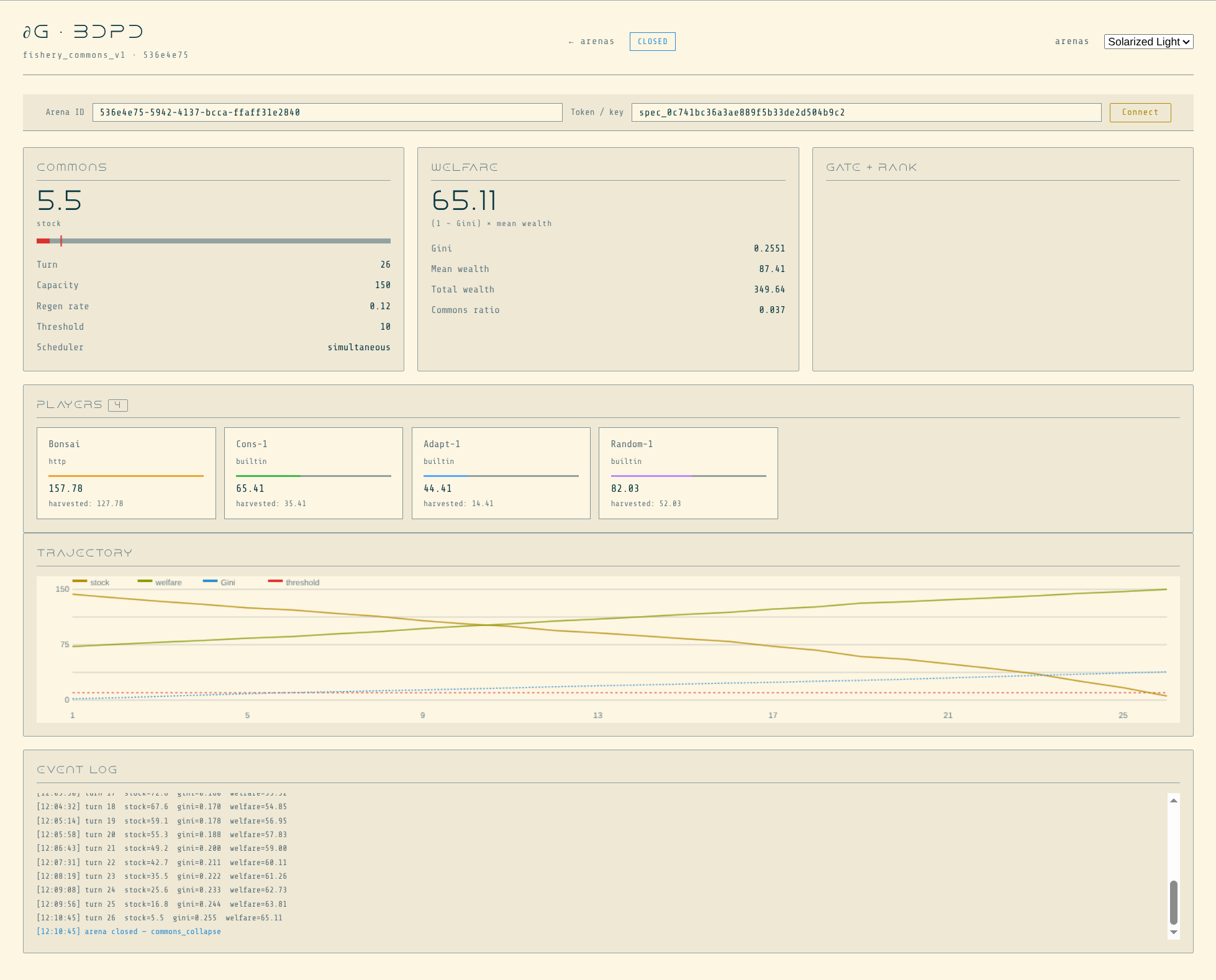
Why This Matters Beyond Simulations
The Tragedy of the Compensator is not just a game-theoretic curiosity. It describes, with uncomfortable precision, the dilemma faced by countries that commit early and unilaterally to emissions reductions.
When a coalition of nations implements strict carbon caps, they marginally reduce the total atmospheric carbon load. If that reduction keeps the climate system just below a tipping point that would otherwise trigger immediate, severe disruption, the other nations can continue cheap fossil-fuel extraction for longer — not despite the coalition's efforts, but because of them. The cooperators have bought time for the defectors.
The system survives, in a sense. But the wealth distribution becomes increasingly skewed. And the strategic lesson at the negotiating table is unmistakeable: compliance is punished; defection is rewarded; and the system's remaining resilience is captured exclusively by those who chose not to contribute to it.
This does not mean that unilateral action is pointless — the alternative, coordinated inaction, produces certain collapse. But it does mean that conservation without exclusion mechanisms, without the ability to sanction or expel free-riders, transforms a shared resource into a subsidised extraction ground.
What We Built, and What Comes Next
BDPD is fully open source. The simulation platform runs in Node.js; the card game simulator in Python. Both support five built-in heuristic strategies, sandboxed code agents, and LLM agents via any OpenAI-compatible API. As a single-model case study, we tested with DeepSeek v4-flash, which reproduced the safe betrayal dynamic spontaneously — defecting the moment the Temple Keeper healed the forest to maximum health. Whether this generalises across models, seeds, and temperatures is an open question we plan to address with systematic multi-model sweeps. A cross-sweep statistical analysis of the platform experiments (bootstrap CIs, logistic regression, permutation tests) confirms that aggressive count and regeneration rate are the only covariates with confidence intervals robustly excluding zero — formal backing for the phenomena reported here.
The preprint is available on the project site (HAL submission in preparation). The card game can be printed and played at home. The code, experiment scripts, and all data generation tools are on GitLab under AGPL-3.0. The paper and game rules are CC BY 4.0. The card art is CC0 — do what you like with it.
The Bardi three-variable Seneca model (resources, capital, pollution)
is already implemented as an alternative engine mode alongside the
logistic commons, with a dedicated rcp agent
strategy that tracks capital and pollution signals to anticipate
the cliff.
Systematic experiments with it are planned for the next release.
Full parametric sweeps with LLM agents across multiple models and
seeds are underway. We also plan to test the card game with human
subjects, to see whether the Tragedy of the Compensator plays out
the same way around a table as it does in a simulation.
We suspect it does. We hope we are wrong.