The Slow Catastrophe Has a Tell
When a forest dies, when a fishery collapses, when a climate tips — the signal we watch arrives late. The signal we should watch is the boom that precedes it.
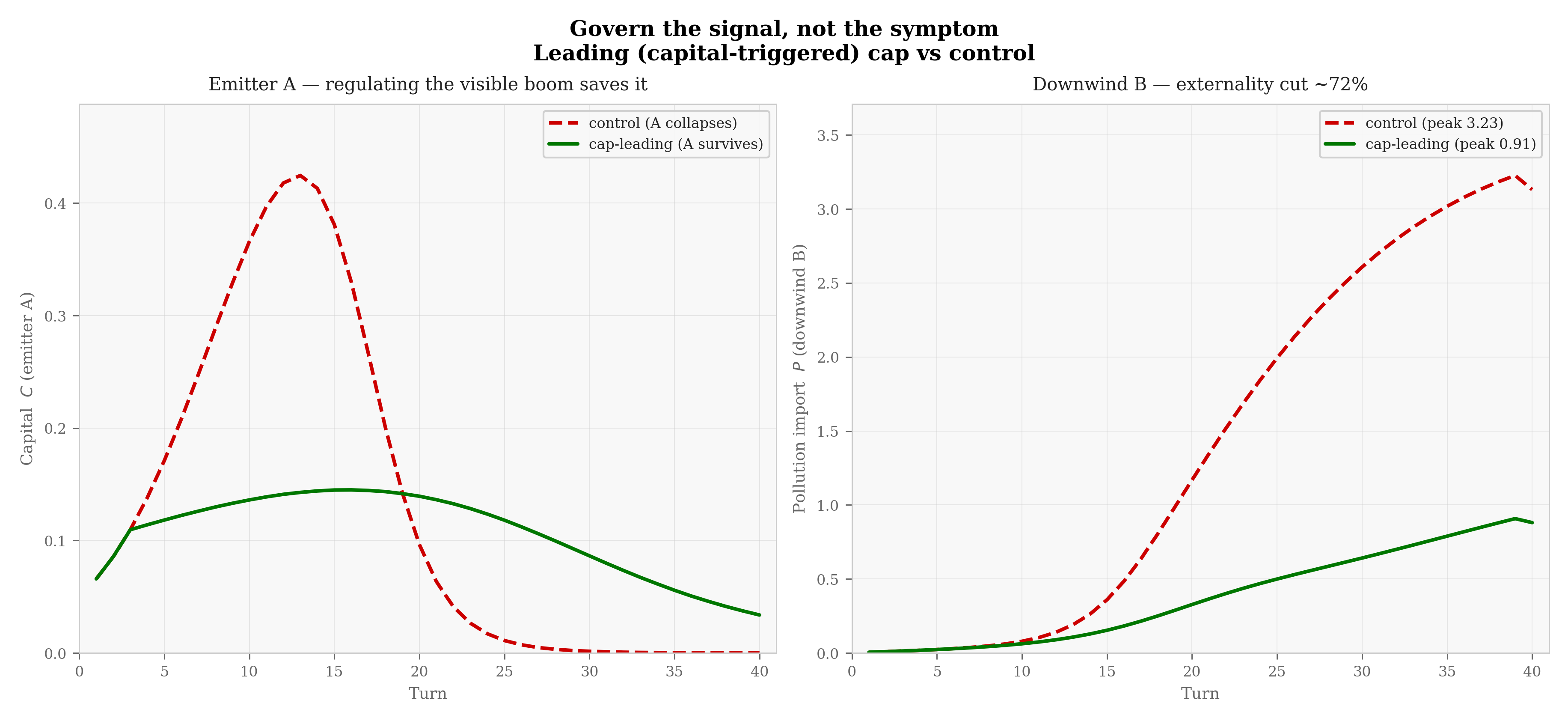
The BDPD³ S3 win-win cell. The emitter A and its two downwind neighbours B and C survive together — but only when the regulator arms its cap on the capital threshold, the leading signal. Triggering the same cap on pollution is structurally too late.
Slow catastrophes do not, in the end, surprise us by how they look. They surprise us by the moment we decide to look. By the time the obvious symptom is undeniable — fish stocks vanishing, ice shelves calving, smog congealing over a city — the system has already passed the threshold at which a recovery is structurally possible. The cliff Seneca described two thousand years ago is, on the slow side, made of decades, and, on the fast side, made of years.
BDPD³, the fourth paper in our series, set out to ask a quiet operational question about this. If a regulator gets to intervene exactly once and exactly through one signal, which signal should it watch?
The instinctive answer is the variable that looks like the problem. Pollution. Carbon load. Nitrate concentration. Sediment plume. We have a moral and institutional preference for symptoms. The story we tell ourselves about governance is that you watch what is going wrong, and you intervene against it.
What the BDPD³ S3 experiment shows is that, for a certain mathematical class of systems — and our most urgent ones belong to it — that instinct is structurally too late.
The Engine We Built
Underneath BDPD³ sits a substrate the Italian chemist Ugo Bardi proposed in The Limits to Growth Revisited and refined in The Seneca Effect. It is a three-variable ordinary differential equation. A natural resource $R$ — call it a forest, a fishery, a fossil deposit — is consumed by an industrial capital stock $C$. The act of consumption produces pollution $P$, which degrades both the capital and the resource.
Written out:
dC/dt = +k₁·R·C − k₂·C·P − l₁·C
dP/dt = +k₂·C·P − l₂·P
Three variables, three equations, a handful of constants. The system has a characteristic behaviour that earned its modern name. Capital $C$ grows slowly as long as the resource $R$ sustains it. Then $R$ runs out. Then $C$ collapses, fast. The collapse is not a softening; it is a cliff. And $P$, the pollution, ignites late in the boom and outlasts everything — a slow, smouldering tail to the industrial growth that produced it.
The shape is uncomfortably familiar. It is the shape of resource economies in the Anthropocene. It is also — and this is the governance question — asymmetric in time. The thing you would want to act on is the boom; the thing that is most visible when you act is the bust.
The Cascade, and Where the Signal Lives
We tested the engine in a polycentric configuration. Three jurisdictions A, B, C, each running its own Bardi/Seneca system. Arena A is an upstream emitter. B and C are downwind. A directional pollution link — a fraction of A's $P$ adds to B's and C's $P$ as an externality, with no compensation flowing back — couples them.
The cascade is not subtle. Without governance, A's industrial boom poisons B and C. Their capital, when measured against the no-pollution baseline, drops by roughly −76%. Their collapse arrives 16 turns earlier. Peak pollution downstream runs at roughly 7.1× the local baseline.
Here is the quiet, counterintuitive piece. In the early phase of A's boom, the resource trajectory of B and C points the wrong way. The poisoned neighbours read as richer, not poorer, because their local industrial activity has not yet drawn down their own resource — the cliff is going to hit them through the inherited pollution before their own capital can take off and consume their own $R$. Anyone watching B's stock chart in the boom phase would conclude the system was fine. By the time the chart tips, the cliff has already foreclosed recovery.
"By the time the pearl is rotten, the oyster has already drowned."
Two Regulators, Same Lever, Different Trigger
S3 ran the same setup with a single world-level regulator added: a governance meta-agent that observes the arenas and applies a pre-declared lever. We tested three levers — a cap on the industrial rate constant $k_1$, a levy on the capital stock $C$, and a fine on household wealth — and two triggers: a pollution threshold $P > θ_P$, or a capital threshold $C > θ_C$.
The cap on $k_1$ is exactly the kind of process ceiling a regulator would consider — a hard limit on the rate at which the industrial process can transform resource into capital. Apply it under either trigger and the question is whether the system survives.
The cap-on-$k_1$ armed by pollution fails. By the time $P$ has risen above the threshold the regulator was watching, the boom has already done enough damage that capping the rate of new capital formation cannot rescue the downwind neighbours. The same instrument, deployed too late, accomplishes nothing.
The cap-on-$k_1$ armed by capital works. When the regulator triggers on $C$ instead — on the boom itself, on the rising industrial stock — the cap arrives in time. Pollution downstream is blunted. The cascade does not propagate. And the most surprising detail of the experiment: the emitter itself survives too. The same instrument that rescues B and C also rescues A. A genuine win-win, and not a hedged or qualified one. The cap-leading cell preserves all three jurisdictions; the cap-reactive cell, armed by pollution, loses all three.
The Negative Control That Tells You Why
A finding is interesting only when you understand why the alternatives fail. We ran one as a deliberate negative control. The fine lever — a wealth shock applied to the households of A's polluting jurisdiction — fails under every trigger we tested. Including the leading capital trigger that makes the cap work.
The reason is structural, and it generalises. In our model there is no demand-to-production channel. Households do not buy the products of A's industry; A's industry produces, and pollutes, on its own economic logic. Punishing households cannot slow the producer because the model does not contain a causal pathway through which household punishment could slow the producer.
This is a small and obvious point made operational. Levers are not substitutable without a theory of the channel they act on. A policy that worked in one institutional setting because households-and-industry were coupled through a market will not work in a setting where that coupling is absent or broken — not because the lever was poorly applied, but because the channel the lever was implicitly assuming is missing.
Reading This Back to the Real World
The lagging-signal mistake has a long history in regulated systems and an awkward number of contemporary cases. The most analytically clean is the fishery example: total catch is observable in real time, fishing capital (fleet size, gear capacity) is observable on a multi-year horizon, and stock collapse — the variable governance statutes most often condition on — arrives last. Regulators trigger on stock; by the time stock has fallen, the fleet has already grown past the size that the recovered stock can support without a second crash. The structural pattern is the same as our S3.
Eutrophication cascades in lake chains — the empirical literature on which informed our cascade design — show a related shape. The upstream nutrient load (nitrate, phosphorus runoff from industrial or agricultural activity) is a leading signal. The downstream visible symptom — algal bloom, oxygen crash, fish kill — is the lagging one. Regulating the visible symptom is too late because the nutrient pulse has already entered the chain.
The atmospheric case is harder, and we are not arguing it on the strength of one model. But the analytic shape is suggestive enough to flag. Emissions are downstream of fossil-capital investment. Atmospheric concentrations and observed climate damage are downstream of emissions. A regulator that triggers on observed climate damage is triggering on the variable that is structurally last to arrive. Triggering on the leading edge — capital investment in fossil infrastructure — is a different proposition entirely.
"The right question, asked at the right time, is itself a kind of answer."
What the Finding Is, and Isn't
We do not claim that S3 settles the fisheries question, or the eutrophication question, or the climate question. It does not. It is one mini-pilot in one substrate, with deterministic agents and a single ODE, run with $N = 1$ at the canonical configuration plus an OFAT structural-robustness sweep across $k_1$, $k_2$, baseFraction, and the time-step $dt$. The mini-pilot tells us that, on the Bardi substrate, the regulator armed by the lagging signal fails, and the regulator armed by the leading signal succeeds. That is what the mini-pilot says, and that is all it says.
What it suggests is that the choice of trigger signal is at least as load-bearing as the choice of instrument, and possibly more. The lever-versus-signal axis is the binding axis; instrument choice is downstream of it. This is a small and concrete claim, in a paper that tries to be careful about not generalising beyond the model. We think it is a claim worth carrying carefully into the empirical literature on real cascading systems.
The next round of work, by way of full disclosure, is supposed to test exactly this: pollution-link topologies more complex than A→B/C, multi-leader cascades, treaty designs that pre-commit on leading rather than lagging variables. Whether the same pattern survives when the model gets more complicated — when there are multiple emitters, multiple regulators, agents that can defect on treaties — is what BDPD³'s campaign-scale extension is for.
The Tell Is Not in the Smoke
There is a familiar narrative architecture about catastrophe in which the catastrophe announces itself. The plume thickens; the siren sounds; the regulator intervenes. It is the architecture of industrial accidents, of fires, of natural disasters. It rewards the institutions we have built to detect symptoms and respond to them.
The catastrophes we are now most worried about do not have that architecture. They are slow, asymmetric, and structurally signal their arrival through the boom that precedes them, not the bust that defines them. To watch the bust is to watch a variable that arrives late. The tell is upstream — in the build-up of capital, in the rate of new investment, in the leading indicators of the boom.
The Seneca cliff is not a surprise. It is a tell we have been told to ignore.