What a Card Game Knows That a Differential Equation Doesn't
We built a differential equation to study a fragile commons. We also built a card game with cedars and a forest die. The card game saw something the equation didn't — and the equation later confirmed it.
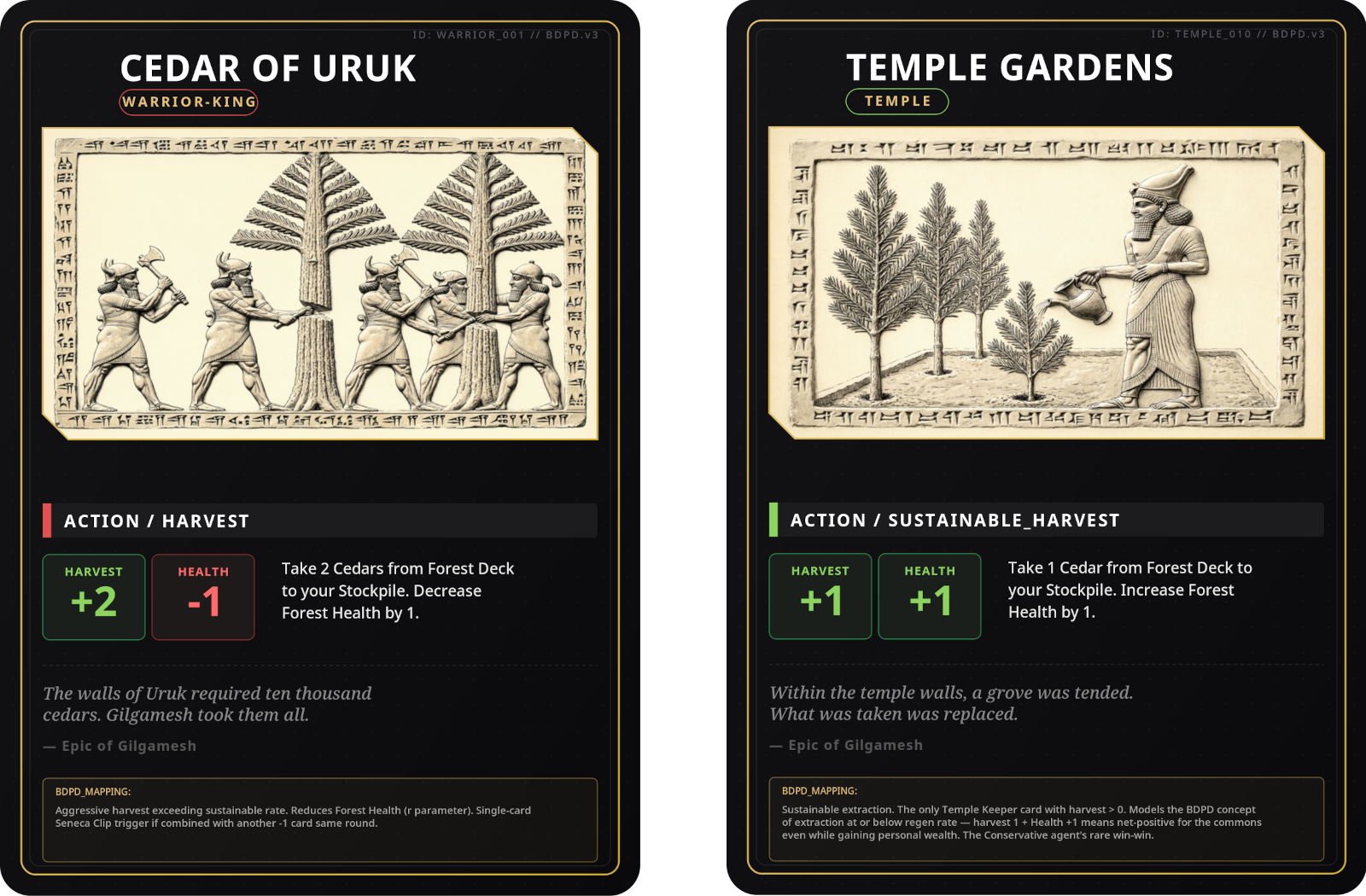
Four archetypes from The Forest of Humbaba: the Warrior-King (aggression), the Temple Keeper (conservation), the River Merchant (adaptation), and the Stranger-King (the patient defector). Each deck is a strategy made of cardboard.
There is a temptation, when you build a simulation, to believe that the simulation is the laboratory and the rest is illustration. The equations produce numbers; the numbers produce confidence; the confidence produces a paper. The card game we ship alongside BDPD — The Forest of Humbaba — was supposed, in the original project plan, to play that illustrative role. It was going to be a teaching device. A way of making the platform's findings legible to people who do not read scatter-plots.
What actually happened is that the card game found a phenomenon before the simulation did. The phenomenon was small and specific. It was also the one our platform paper ended up turning on. And once you have had a methodological surprise of that shape, you cannot quite go back to the prior in which the tabletop is a pedagogical accessory.
Two Instruments, Two Substrates
The BDPD platform is a Node.js multi-agent laboratory. A commons regenerates logistically; players harvest each turn; perturbations shake the system; sweeps across thousands of runs measure where the survival surface lives. The platform is the kind of instrument that produces statistical regularities. Its outputs are histograms and slopes. It does not produce intuition. It produces evidence.
The Forest of Humbaba is a tabletop card game set in the world of the Epic of Gilgamesh. Players compete for cedars from a sacred forest. Every mechanism in the platform has a physical translation. The commons stock is the Forest Deck. The hidden reserve under the canonical-collapse threshold is the Box Reserve. The stochastic collapse roll is a Forest Die. The asymmetric Seneca cliff is a Seneca Clip — a literal red card that turns growth into decline. There are four archetypal decks. There are events. There is a Stranger-King who must defect at or before round seven.
The card game produces something the platform does not, and could not. It produces the felt sense of a system tipping. A player can see, in their own hand, the cedar they are about to take. They can feel the moment when they decide that this round is the round to push too far. They can feel the slack that the Temple Keeper is building. They can feel the temptation to spend it.
What the card game does not produce is statistics. Two games are not a distribution. Two hundred games on a tabletop are unrealistic to run. So we built a card-game simulator — the same rules, executed by a Python script with stochastic deck-shuffles and archetype-blind random card selection — and sweep it for 200 games per data point. The simulator is the bridge. The play is the pedagogy. The simulator runs the statistical experiments that the play could only feel.
The Surprise: Safe Betrayal
The first time the Stranger-King beat the Temple Keeper in our pilot tournaments was not, statistically, a finding. It was an anecdote. We tried two-archetype matchups exhaustively. Most of them confirmed the obvious — the Warrior-King usually destroys the forest; the Temple Keeper rarely accumulates personal wealth. Stranger versus Temple was supposed to be a slow defection that occasionally collapsed the forest.
What we saw, repeatedly, was something else. The Stranger-King would cooperate through the early rounds while the Temple Keeper healed the forest. Then the Stranger would flip the Defection Token and extract aggressively. The forest, having been healed, had room to absorb the burst. The forest survived. The Stranger walked away with substantially more cedars than if it had cooperated all along. The Temple Keeper walked away with effectively none.
On a tabletop, this is the sort of thing you remember for years. The person across the table from you has subsidised your defection with their own conservation. You both know it. They watched it happen move by move. And they cannot — within the rules — punish you.
The CT4 simulator sweep formalised the anecdote. Across 200 games per defection turn, against the Temple Keeper, the Stranger-King accumulated up to +27% more wealth than its no-defection baseline, while the collapse rate stayed below 10%. Defection went up, forest survival did not go down, and the Temple Keeper was the one paying the cost.
We did not name the phenomenon yet. We had to look for it in the platform first.
The Differential Equation Catches Up
On the platform side, we had been studying a different question: what does the strategy override do — a player who starts cooperative and switches to aggressive at a programmed turn? We called this sweep P11, "The Mule". Four agents, three conservative and one mule; the mule defects at turn $T \in \{5, 15, 25, 35, 45\}$ on a 60-turn horizon. We wanted to find the safe defection timing — the turn early enough to accumulate wealth, late enough that the commons has stockpiled the resilience to absorb it.
The answer the platform gave us was sharp and bracing. There is no safe timing. Even defection at turn 45 — after 45 turns of full cooperation — drives the gate pass rate from 100% to 0%. The structural fragility of the cooperative equilibrium to timed betrayal, in the simulation, is total. We could not find a cell in the sweep where late defection failed to collapse the commons.
This was, on the surface, the opposite of what the card game had shown. In the simulation, defection always collapses the commons. In the card game, defection against the Temple Keeper does not.
The reconciliation is the key methodological move of BDPD⁰. The simulation runs against a population of conservatives who extract a moderate fixed share. They do not heal the commons; they just extract less. The Temple Keeper's deck, by contrast, contains active healing cards — cards that add cedars back to the Forest Deck, that grant Forest Health, that physically scoop slack back into the commons. The card game's Temple Keeper is not the simulation's conservative. The Temple Keeper is a strict compensator, and the simulation's conservative is not.
In a preliminary, unpublished extension of the platform sweep with an explicit compensator archetype — an agent that under-extracts on purpose and so leaves slack the aggressive partner can exploit — the safe-betrayal structure reappeared in the platform numbers. The card game had not been wrong: it had been studying a strategy the platform's default heuristics did not yet contain. A campaign-scale replication of this compensator follow-up is part of the planned post-v1.1 work.
"The card game produces intuition.
The platform produces statistics.
Each instrument finds what the other is too coarse to see."
The Divergence That Becomes a Finding
Safe betrayal is the case where the card game led and the platform confirmed. There is a complementary case where the divergence between substrates is itself the finding.
In the platform, observation noise on the commons stock is a surprisingly useful institutional variable. Moderate noise — roughly 35–50% — improves collective welfare relative to perfect transparency, by blunting the precision with which aggressive agents can free-ride on the cliff edge. The finding has a clean institutional moral. Some informational fog is welfare-optimal, when the agents in the system are sophisticated enough to condition on stock signals.
The corresponding card-game sweep, CT3, reproduces the noise design exactly. We add a stochastic redaction to the Forest Deck count visible to players. We sweep noise from 0% to 100%. We measure collapse rate, Gini coefficient, average per-player stockpile.
The card-game result is statistically flat. Noise has no welfare effect at all on the demo-mode card game. The collapse rate sits at roughly 0.41 across the entire noise sweep. The Gini is essentially constant. Average stockpiles do not move. The card game's archetypes, which play randomly from their decks rather than conditioning on the observable stock, are structurally blind to the visibility signal. The fog is irrelevant to the blind.
The divergence is itself the finding. The platform shows that moderate noise improves welfare when agents condition on the stock signal. The card game shows that the welfare effect disappears when agents do not. Read together, the two results triangulate the mechanism more sharply than either could alone. Noise matters because of cognition. Without cognition, noise is just noise.
Why a 4,000-Year-Old Forest
There is a separate question of why the card game ended up wrapped in Bronze Age myth at all. The structurally honest answer is that the abstraction needed a name, the name needed a forest, and the forest needed to be old enough to feel non-negotiable. Cedar plantations would not have done it. The Sahel would not have done it; the Sahel is still a contested case. We needed a place whose deforestation has already happened, whose loss is undisputed, whose felling is the load-bearing image of a civilisation reaching past its substrate.
The Cedars of Lebanon are that forest. Gilgamesh and Enkidu went to them with axes. Mesopotamian kings imported their timber and inscribed their names on it. Humbaba — the demigod the Epic gives them to fight — is the friction the forest puts up before it is taken. The mythology gave us a way to talk about an act whose meaning is not technical. It is not "the commons is collapsing"; it is "the god of the forest is dying, and you are the one with the axe".
That register matters for what the tabletop instrument is for. Playing the Stranger-King is not a sanitised choice between abstract harvest values. It is a choice you have to make over a physical card with a name on it, in front of a person you have been pretending to cooperate with for an hour. The shame and the surprise that the platform cannot measure are right there in the room.
The Methodological Claim, Carefully
We do not argue that every quantitative model needs a tabletop twin. Many do not. The methodological claim BDPD makes is narrower. For systems whose dynamics depend on the cognitive architecture of the agents inside them — for systems where the institutional question is partly a question about what the agents can perceive, decide, and pre-commit to — a dual-mode laboratory contributes something a single-substrate model cannot.
The card game catches strategies the simulation's heuristic library does not yet contain. The simulation tests, at scale, hypotheses that the card game can only flag in two games. When they agree, confidence rises. When they disagree, the disagreement is the finding — it points at the cognitive ingredient that the diverging substrate is missing.
What the Card Game Does Not Know
The complementary observation is that the card game is bad at the things the platform is good at. We could not have run the BDPD¹ governance sweep on a tabletop. The graduated-versus-flat sanctioning comparison requires 25 LLM games per cell across five seeds at 30 turns each — three full days of API calls. The Seneca pollution cascade requires three coupled ODE systems with micro-stepped integration. Neither of these is something a cardboard substrate could host.
The right framing of the BDPD dual-mode laboratory is that the two instruments are complementary in their failure modes. The platform cannot find a strategy that is not in its heuristic library. The card game cannot run a 200-cell statistical sweep. The platform treats the agents as code. The card game treats the agents as cardboard, or as the people holding the cards. Each substrate is blind to a different ingredient. The science of the project is the systematic comparison between the two.
The Next Player at the Table
The natural next step, and the one we are organising now, is human-subject play. Whether the safe-betrayal pattern reproduces when the Stranger-King is a person who has to look at the Temple Keeper across the table — whether the social cost of being seen to defect is enough to suppress the betrayal that the simulation and the random-play card sweep both find — is an empirical question we cannot answer from agents alone. We suspect the pattern attenuates but does not vanish. We hope we are wrong.
Either way, the answer will live in the same instrument. The Forest of Humbaba can be printed and played at home; the card-game simulator can replay the same protocol with random agents and with LLM agents; the platform can sweep the same strategic axes at scale. The human players, when they arrive, will join a setup that already has the other two substrates wired in.
That, in the end, is the methodological move we did not predict at the start. We thought we were building a tabletop accessory to a simulation. What we built was a triangulating instrument. The platform produces statistics. The card game produces intuition. The next round will produce something neither of them can: behaviour with a face and a name across the table from you.