5 You Can’t Save the Polluter by Punishing Households
Three regulatory levers walk into a Seneca cascade. Two of them have a chance of working. The third — punishing the wallet of the citizen rather than the rate of the factory — fails under every trigger we tested. Why it fails is the lesson.
Roberto Brunelli · Independent Researcher · June 2026 · BDPD v1.1 · 13 min read
BDPD3 S3. Three levers (cap, levy, fine) and two trigger signals (capital, pollution). The fine column is structurally blank: there is no cell, under any trigger, in which it rescues the downwind cascade. It is the negative control that earns its name.
The instinctive language of environmental policy treats levers as a grocery list. There is a carbon cap; there is a carbon tax; there is a household rebate or surcharge. They are presented, in the sentence after the sentence that names the problem, as variants of the same intervention. The question is taken to be a question of political feasibility — which lever can be passed? — not of structural plausibility — which lever can work?
Our experiment ran the structural question. We deliberately picked a lever that was not going to work, ran it through the same trigger signals as the levers that do, and watched it fail in exactly the way our theory predicted. The fact that it failed is less interesting than why it failed. The why generalises.
5.1 The Levers, and What They Touch
The substrate is the Bardi/Seneca three-variable ODE: a natural resource \(R\) that an industrial capital stock \(C\) consumes, which in turn generates pollution \(P\), which degrades both. We coupled three of these systems together — arenas A, B, C — with a directional pollution link so that A’s emissions chokes its downwind neighbours.
A world-level regulator gets to apply one of three levers when its trigger fires:
The first two levers act on the producer. The third acts on the customer. In the standard policy taxonomy these are equivalent framings — a fine on consumption is supposed to suppress demand, which suppresses production, which suppresses pollution. The transmission is mediated by a market.
Our model does not have that market. There is no demand schedule in the Bardi/Seneca substrate. Capital \(C\) grows from resource \(R\) by an autocatalytic rule: industrial capacity that exists produces more industrial capacity, modulated by the resource it eats and the pollution it makes. Nowhere in this loop does \(C\) check what households want, or notice that they are poorer, or slow itself down because someone has been taxed.
The omission is deliberate, and it is the entire point of the experiment. By not wiring a demand-to-production channel into the model, we made the fine lever’s success impossible by construction. Whether or not the demand-to-production channel exists in any given real-world case is exactly the empirical question a serious policy analysis has to answer. Our model says nothing about whether that channel exists. Our model says, very clearly, what happens if you legislate as though it does when it does not.
5.2 What Happened, By Trigger and By Lever
We armed each lever with each of two triggers — pollution \(P\) above a threshold (a lagging signal) or capital \(C\) above a threshold (a leading signal) — and ran the cascade to closure.
The result was clean enough to summarise in a sentence each:
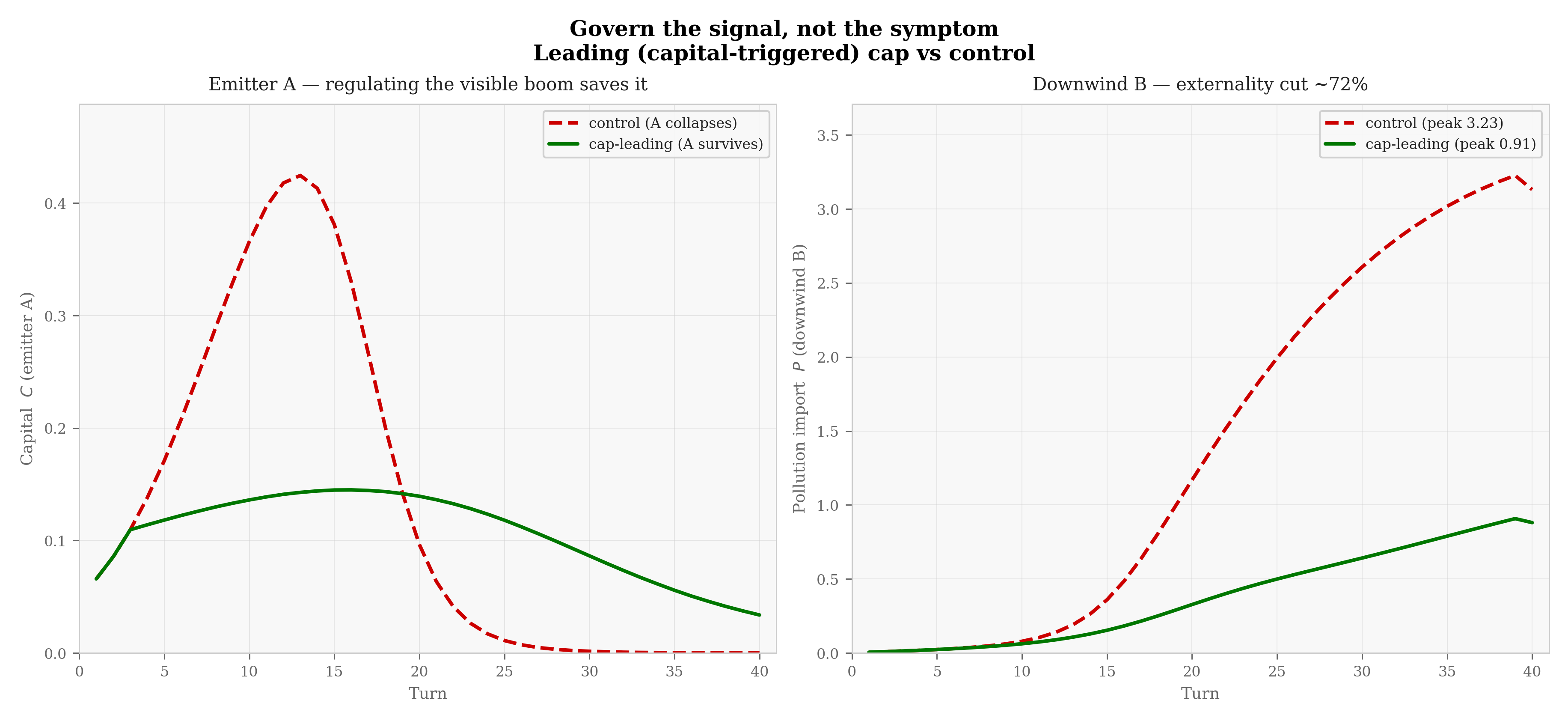
- cap-leading — armed by capital — rescues all three jurisdictions. The win-win.
- cap-reactive — same lever, armed by pollution — fails. The signal is too late.
- levy-leading — armed by capital — also rescues all three: it recovers B more than cap-leading (+31.6% vs +19.7%) while holding A’s capital to a lower plateau, so the emitter still survives.
- levy-reactive — fails on the same lagging-signal grounds as cap-reactive.
- fine-reactive — fails as a negative control: the model has no demand-to-production channel through which fining households could slow the producer.
- fine-leading — not run as a separate cell: paper_03 §Limitations argues the same channel-absence makes it predicted to fail by construction, so the negative control above is the only cell that needs to be executed.
The diagonal pattern that organises the table is the trigger finding from the headline S3 result — leading signals beat lagging ones. The column the fine lever sits in is what concerns us here. The fine lever fails under every trigger. It fails when the regulator triggers too late (which is the same failure as cap and levy under the lagging signal). It also fails when the regulator triggers in time — a configuration in which cap and levy both work.
The signal arrived. The instrument was deployed. The instrument was the wrong instrument.
5.3 The Lesson, Stated Carefully
The negative control says something narrow and something interesting. The narrow thing is what we already knew: a model without a demand channel will not reproduce policy interventions that depend on a demand channel. That is a tautology.
The interesting thing is what the tautology forces us to notice. Policy levers carry implicit assumptions about the causal channels through which they act. The fine lever, in real-world arguments, is rarely defended as “punishing households”. It is defended as incentivising them: making the polluting good more expensive so they buy less of it, so producers make less of it, so emissions fall. That whole argument is the demand channel. Without it, the fine collapses to its other meaning — a transfer of pain to the people least proximate to the production decision.
“A tool is the trace of a theory about the thing it is used on.”
If you remove the channel and keep the lever, you have a policy whose stated purpose is to reduce pollution but whose effective purpose is to redistribute pain. This is not a hypothetical pathology. It is a recurring complaint about a class of environmental fiscal instruments: that they hurt the people they are nominally trying to recruit into the solution, and they do so because the channel through which the lever was supposed to act on production is missing, broken, or not as strong as the policy architecture had assumed.
5.4 Two Real Cases Where the Channel Has Been Missing
The clearest contemporary case where this distinction is being fought out is the yellow-vest pattern of fuel-tax revolts. The instrument was a tax on a household-facing good — petrol — sold on the theory that consumers would substitute toward cleaner transport. In the affected jurisdictions, the substitution channel was weak (rural commuting, no rail alternative, no near-term electric option). The tax did not displace the consumption it was nominally trying to displace. What it did instead was redistribute the cost of the transition to households that could least absorb it. The political backlash followed structurally.
A second case, less politically charged, is the long-running debate over container deposit schemes. The instrument is a small surcharge applied to the household; the demand channel is the assumption that the household will return the container to recover the surcharge. Where the return infrastructure is dense and convenient, the channel works and recycling rates climb sharply. Where the infrastructure is thin, the surcharge becomes a regressive fee with no behavioural traction. Same instrument; the channel decides whether it functions.
5.5 The Failure Mode This Maps
Where BDPD3 S3 makes a slightly different contribution is in naming the failure mode structurally, before any political argument about feasibility starts. The Bardi/Seneca substrate is small enough — three variables, three equations, three jurisdictions, three levers — to make the absence of a channel visible. There is nowhere in the model for the household-wealth shock to propagate to the production rate. So it does not propagate. So the lever fails. So we can name the lever as a negative control, and the negative control becomes the diagnostic.
The diagnostic generalises: before reaching for a lever, name the channel it is supposed to act on, and ask whether that channel exists in the system you are intervening on. If the channel does not exist, the lever’s instrumental purpose collapses to its distributional purpose. If you wanted to redistribute, you can keep the lever. If you wanted to reduce the pollution, you need a different instrument or you need to build the channel the instrument was assuming.
5.6 What the Experiment Does Not Say
A negative control in a model is not a claim about the world. It is a claim about the model. Our model excludes the demand-to-production channel by construction. A model that explicitly included household demand, a market clearing condition, and a producer responsiveness function would have the channel; a fine on consumption in that model could in principle succeed.
What our model is good at is making the assumption legible. In BDPD3 the fine lever fails because the channel is absent. If a policy argument is going to lean on the fine lever, the argument has to explain — explicitly — why the channel that our model omits is present in the case at hand. The burden of evidence is on the channel, not on the lever.
This is the modest version of the lesson. It is also the version most useful for arguing about environmental policy in good faith: distinguish the instrument from the channel, and demand evidence about the channel.
5.7 Companion Reading
This essay is the companion piece to The Slow Catastrophe Has a Tell, which tells the trigger story: why arming the right lever with the wrong signal fails. Read together, the two pieces say something tighter than either alone. The choice of trigger signal and the choice of lever channel are both load-bearing, and they fail independently. A regulator can have the right instrument and the wrong signal (the cap-reactive cell); the wrong instrument with the right signal (the predicted fine-leading failure, not executed because the model precludes any positive channel); the wrong of both (the fine-reactive cell, run as the negative control); or get them both right (cap-leading, the win-win). Three of the four cells are failure modes. Only one is rescue. The structural geometry of the failure is what BDPD3 S3 contributes.