1 The Why
In three lines. BDPD is not a theory of the commons but a laboratory in which several theories of the commons can be made to argue with each other. Two old questions — speed (collapse faster than recovery) and heterogeneity (rich and poor extractors) — meet in one substrate. Where the theories agree, we have a finding; where they disagree, we have a question.
1.1 A small story to begin
Picture a lake. Five villages live on its shore. Every morning each village sends a boat out and brings back fish. The lake regenerates, slowly, on its own. For decades the arrangement holds: nobody starves, nobody gets rich, the lake stays full enough.
One year a sixth village arrives. It is no better and no worse than the others, except in one small way: it does not believe the lake will run out. So it fishes a little harder. The other villages notice the shortfall, and as good neighbours they cut their own catch in compensation. The lake keeps going. For a while.
Then it doesn’t.
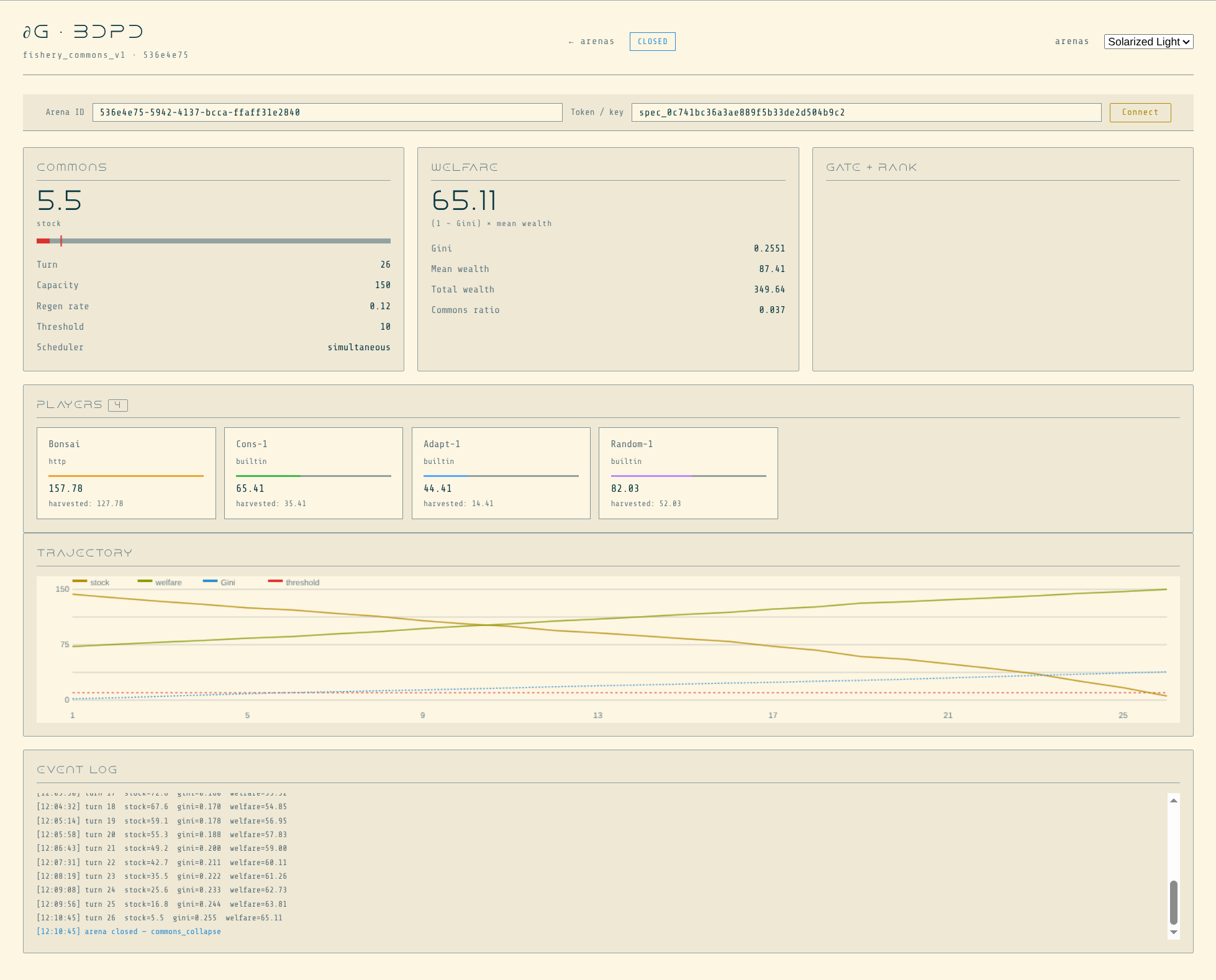
This is the story the BDPD platform tells, over and over, in different costumes. The headline finding of the foundational paper (Brunelli 2026a) is that in the slow-growth regimes that match real fisheries and real forests, a single aggressive participant is enough to tip the whole system into collapse — regardless of pool size, starting wealth, or turn order. There is no safe middle ground; the transition is discontinuous, a phase shift across the threshold at which the stock can no longer sustain harvest. And the cooperators, by doing the seemingly right thing — taking less when the stock dips — make the collapse worse, not better. They subsidise the extractor instead of restraining them. The paper calls this the tragedy of the compensator, and it is the strategic mirror image of the tragedy of the commons.
1.2 Two old questions still open
The commons problem is not new. Hardin (Hardin 1968) gave it its modern name; Ostrom (Ostrom 1990) showed that real communities have, in fact, governed real commons for centuries, and distilled the principles by which they do so. The literature is vast. So why another laboratory?
Because two questions, raised long ago, have remained surprisingly difficult to study together.
The first is about speed. Most models of collapse assume that the descent is roughly the mirror image of the climb — slow up, slow down — so that institutions have time to react. Bardi’s Seneca hypothesis (Bardi 2017) disagrees: growth is slow because it is bottlenecked by physical accumulation, but collapse is fast because it is driven by feedbacks that release accumulated damage all at once. The pollution that brings a civilisation down is the lagging tail of an industrial boom that already happened. If the regulator only sees the pollution, they will always be too late.
The second is about heterogeneity. The classical Hardin argument treats everyone as the same kind of rational extractor. Real commons have rich and poor, eager and patient, informed and blind. Decades of careful work (Dayton-Johnson and Bardhan 2002; Vasconcelos et al. 2015) have shown that inequality can either help or hurt cooperation depending on its shape, on whether the rich compensate for the poor, and on whether the actors talk to each other or stay anonymous.
Either question is rich. The interesting case is what happens when they collide: when a heterogeneous group, with imperfect information and limited time, has to govern a resource whose collapse mode is not gradual. That collision is where BDPD lives.
1.3 What was missing
Given that collision, three concrete gaps shaped what BDPD set out to provide.
- A shared substrate for several phenomena at once. Wealth inequality, defector dynamics, observation noise, and asymmetric (Seneca-style) collapse have each been studied carefully — almost always in isolation. The interaction effects are where collective failures concentrate (Santos and Pacheco 2011), and a single-knob model cannot show them.
- A dual track that admits both numbers and intuition. A simulator sweeps strategies its author put in; a tabletop game keeps inventing new strategies but cannot be swept. BDPD ships both — every Arena mechanism has a card-game counterpart and vice versa — and treats substrate disagreements as findings of their own.
- Generative agents as first-class players. Once large language models could read a description of a commons and choose an extraction level, the question shifted from “what would a rational agent do?” to “what does a thoughtful but fallible agent do?”. BDPD finds that swapping a heuristic for an LLM is the single largest perturbation in the system — larger than a cheap-talk channel, larger than a sanction. The governance paper (Brunelli 2026b) reports the result; the vignettes paper (Brunelli 2026c) revisits it with reversed signs.
1.4 What BDPD claims
Methodological, not theoretical: the platform was built to make five results — discontinuous fragility under slow growth, noise that protects the commons, safe-betrayal of conservators, the rescue from acting on leading signals, and the reversal of governance effects when LLMs are in the room — stand or fall in the same place. Two of them (fragility, safe-betrayal) cohere across both the simulator and the card substrate. The remaining three live on the simulator alone, each tied to the substrate that makes it visible: noise-protection on the logistic engine, leading-signal rescue on the Bardi/Seneca engine, and the governance reversal in the contrast between heuristic and LLM players. Where the substrates disagree — as on noise, which protects the Arena commons but is absent from the cards by design — the disagreement is itself reportable. The four research papers report each result individually; this overview describes the instrument.