2 The What
In three lines. BDPD pairs a multi-agent simulator (two swappable physics, a heuristic library and LLM players, a small governance toolkit) with a card game (four archetype decks, the room where humans invent strategies the simulator has not encoded). Around them sit four research papers (BDPD0–3) and a constellation of outreach. Architecture-beats-channel is the headline result the rest of this overview earns.
2.1 What ships, in one table
| Layer | What it is | Why it matters |
|---|---|---|
| Arena (simulator) | Turn-based engine; two swappable physics (logistic commons, Bardi/Seneca ODE); polycentric coupling on top | Lets several theories of the commons run on the same clock; substrate becomes a parameter |
| Players | Heuristic library (Conservative, Aggressive, Adaptive, Mule, RCP) + LLM agents (DeepSeek v4 by default; any OpenAI-compatible endpoint) | Same world, two cognitive regimes; swapping a heuristic for an LLM is the single largest perturbation in the system |
| Governance toolkit | Pact registry, cheap-talk channel (6 message primitives), flat fine + graduated sanction ladder, monitoring metrics | Operationalises Ostrom’s design principles as composable code; lets the platform test which pieces actually preserve a commons |
| Forest of Humbaba (cards) | Cooperative-with-defection card game; four archetype decks (Warrior-King, Temple Keeper, River Merchant, Stranger-King) | The substrate where humans invent strategies the simulator has not encoded; safe-betrayal was discovered here first |
| Four research papers | BDPD0 (platform & fragility), BDPD1 (governance: cheap talk + sanctions), BDPD2 (vignettes: LLM cooperators co-breach pacts), BDPD3 (Seneca polycentric: leading-signal regulation) | The empirical findings the instrument was built to support |

The rest of this chapter walks the rows.
2.2 The Arena: a simulator that can change its physics
The Arena is the multi-agent simulator at the heart of the project. Underneath, it is a turn-based engine with a pool of resource, a set of players, and a clock. What makes it distinctive is that the physics of the pool can be swapped out without touching the players, the governance machinery, or the analysis pipeline. Two engines ship in the box, and a composition layer lets them be wired together.
The default is a logistic commons: the pool regenerates at a rate that grows with stock until carrying capacity, then slows down. This is the canonical model of a fishery or a slow-growth forest, and it is the substrate on which the foundational fragility result was first established (Brunelli 2026a).
The second is a Bardi/Seneca three-variable engine in which a renewable resource R, an industrial capital stock C, and a pollution stock P interact through the feedbacks Bardi formalised (Bardi 2017). Here collapse is asymmetric by construction: pollution lags capital, capital lags resource extraction, and a regulator who acts on the visible damage is structurally too late.
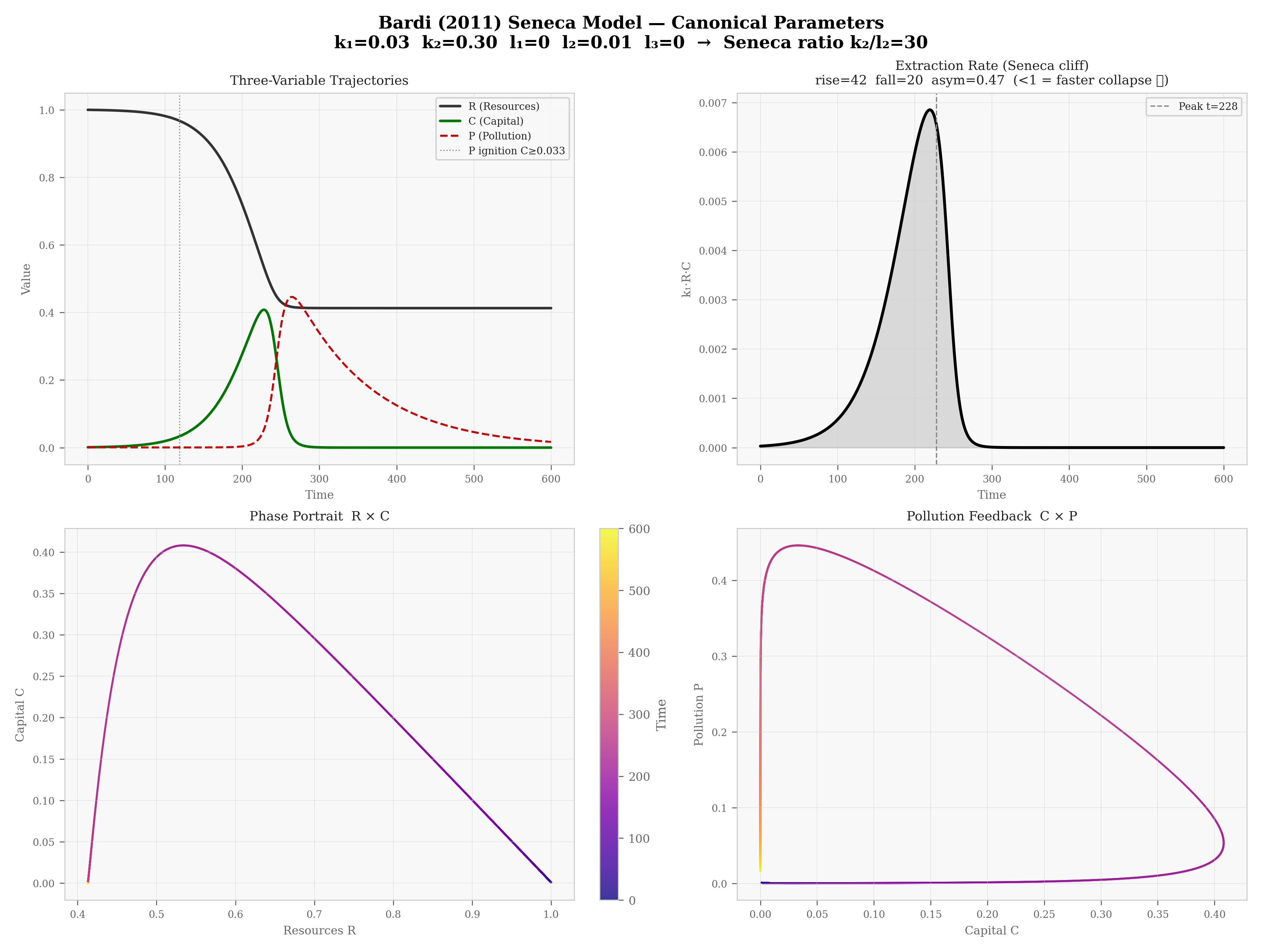
On top of the two engines lives a polycentric coupling: several Bardi worlds can be run side by side and linked by a directional pollution flow from upwind to downwind jurisdictions. The coupling is not a third engine but a composition over the existing one — a cap imposed in the upwind world reshapes the dynamics of its neighbours, which is what makes it the testbed for the question of which signal a regulator should act on. The full story is in the Seneca paper (Brunelli 2026d).
A further dimension lives across both engines: observation noise. Agents see the stock not directly but through a noisy channel, and the noise level is a parameter. In the foundational paper this turns out to matter in a counter-intuitive way: noise tends to protect the commons, because it blurs the signal that aggressive agents use to time their extraction.
2.3 The players: a library, plus the LLMs
The Arena ships with a small library of heuristic agents — short, deterministic strategies — that have known properties and can be used as controls. The cast includes an Aggressive who fishes a fixed fraction of the visible stock, a Conservative who tiers its harvest down as the stock falls, an Adaptive who tracks the recent trend in the stock and cuts when it has been falling (paper (Brunelli 2026a) labels this the reactive role and reports the counter-intuitive finding that it does worse for the group than a flat conservative rule), and an RCP agent that lives on the Seneca substrate and anticipates the collapse from the pollution signal even when pollution is hidden. Late defection — the dynamic at the heart of one of the late-cycle pathologies (Brunelli 2026b) — is not a separate agent but a perturbation that flips an agent’s strategy at a chosen turn, the simplest possible model of an actor who plays nice until they don’t.
The other class of player is the large language model. BDPD treats LLM agents not as a curiosity but as first-class participants: they receive the same structured world description as the heuristic agents, choose extraction levels through the same tool-call interface, and are scored on the same metrics. The foundational paper’s headline case study was run on Bonsai 8B; the governance, vignettes, and Seneca papers settled on DeepSeek v4 flash (DeepSeek-AI 2026) as the workhorse for systematic pilots. The platform is model-agnostic — any OpenAI-compatible endpoint can be plugged in behind the same surface.
The empirical claim that follows from this dual cast is striking. In the governance paper, a factorial decomposition (agent architecture vs communication channel) finds that the dominant driver of cooperation is not the channel but the architecture: swapping a heuristic agent for an LLM agent, with no other change, moves preservation from zero out of five seeds to four out of five (Brunelli 2026b) — the result already shown in Figure 2.1. The vignettes paper (Brunelli 2026c) then shows that the direction of governance effects can invert when LLMs are in the room — conformists co-breach pacts that conservatives would have respected — and that the inversion is not marginal: it reverses the sign of the institutional intervention.
2.4 The card game: The Forest of Humbaba
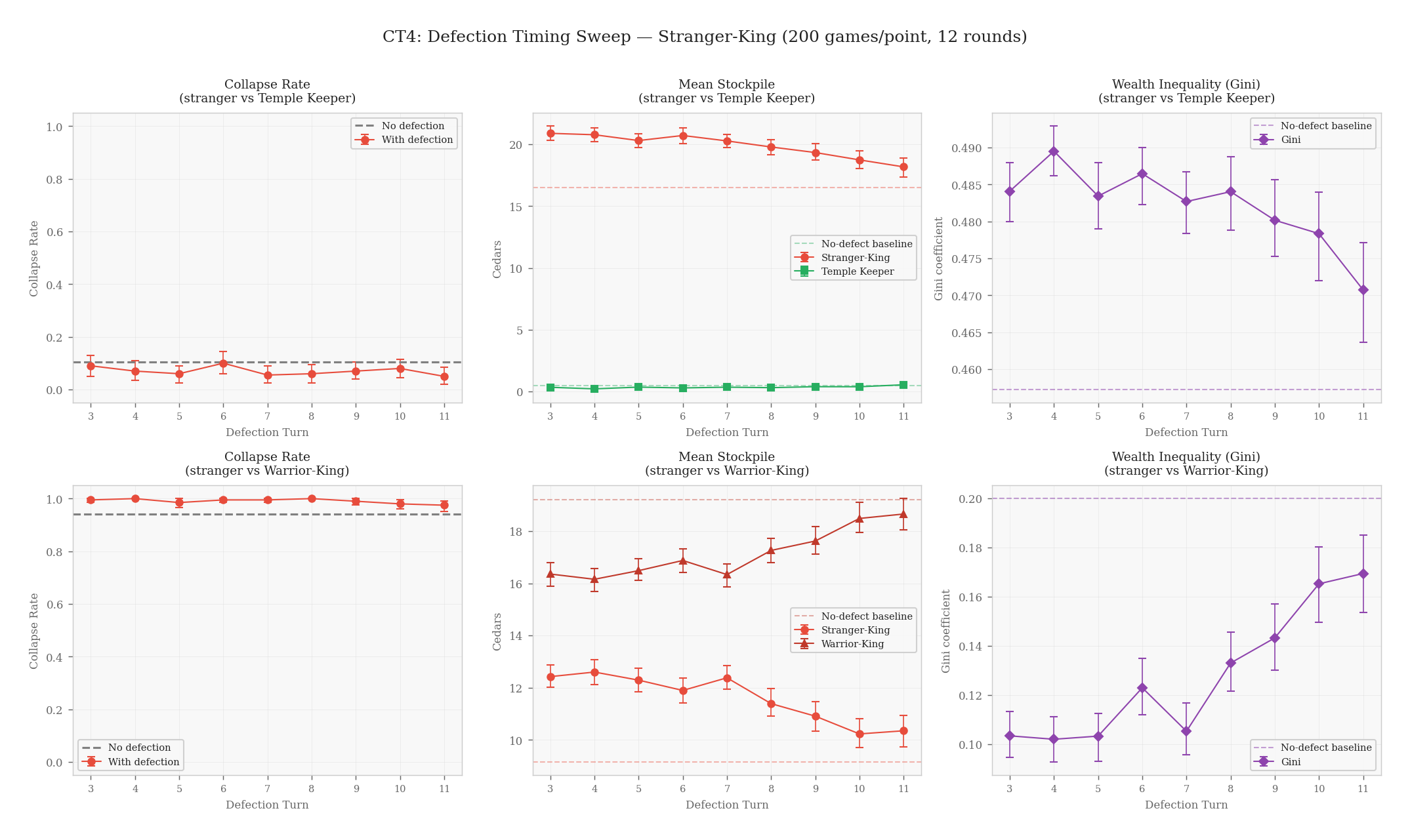
This is where a finding came to BDPD before the simulator could produce it. The pathology called safe betrayal — a defector profits from a conservator’s healing without triggering collapse — was discovered on the tabletop in the CT4 matchup (Stranger-King vs Temple Keeper) before the Arena was extended to reproduce it (Brunelli 2026a). Card-table first, formalised second: the inversion of the usual order is itself the methodological claim.
The substrate is a cooperative-with-defection card game in the cedar forest of the Gilgamesh epic. Four archetype decks — Warrior-King, Temple Keeper, River Merchant, Stranger-King — mirror the Arena’s heuristic library as physical objects with hand sizes, draw piles, and discard rules. The Stranger-King is the timed defector. The game is the room where humans invent strategies the simulator has not encoded; it also anchors the mini-course The Limits of Good Will.
2.5 The governance toolkit
On top of the Arena and its physics, BDPD carries a layer of institutional machinery designed to make Ostrom’s design principles (Ostrom 1990; Cox et al. 2010) addressable as code. The pieces are deliberately small and composable.
A pact registry lets players announce intended actions and binds them to the announcement at the metric level. A cheap-talk channel exposes six message primitives — public broadcast, private message, harvest announcement, pact proposal, pact acceptance, and unilateral pledge — through which players can negotiate. Two sanction modules are provided: a flat fine and a graduated ladder; both are perturbations triggered by the violation of a registered pact. Monitoring metrics expose pact adherence, silent defection, sanction frequency, and a handful of other governance indicators that the analysis pipeline records run by run.
The interesting finding is what these pieces do not do alone. Cheap talk by itself does not save the commons; what it does is redistribute wealth, dropping the aggressor’s earnings by about a third and lifting cooperators by about a sixth (Brunelli 2026b). The intervention that does preserve the commons is the graduated sanction ladder, which preserves four or five seeds out of five depending on the geometry — but a flat sanction of equal expected cost preserves only one. Ostrom’s principles #4 (monitoring) and #5 (graduated sanctions) come out, in this laboratory, as the load-bearing pair: #4 is the necessary condition for #5 to fire at all, and #5 is the mechanism that preservation tracks.

2.6 The polycentric layer: leading vs lagging signals
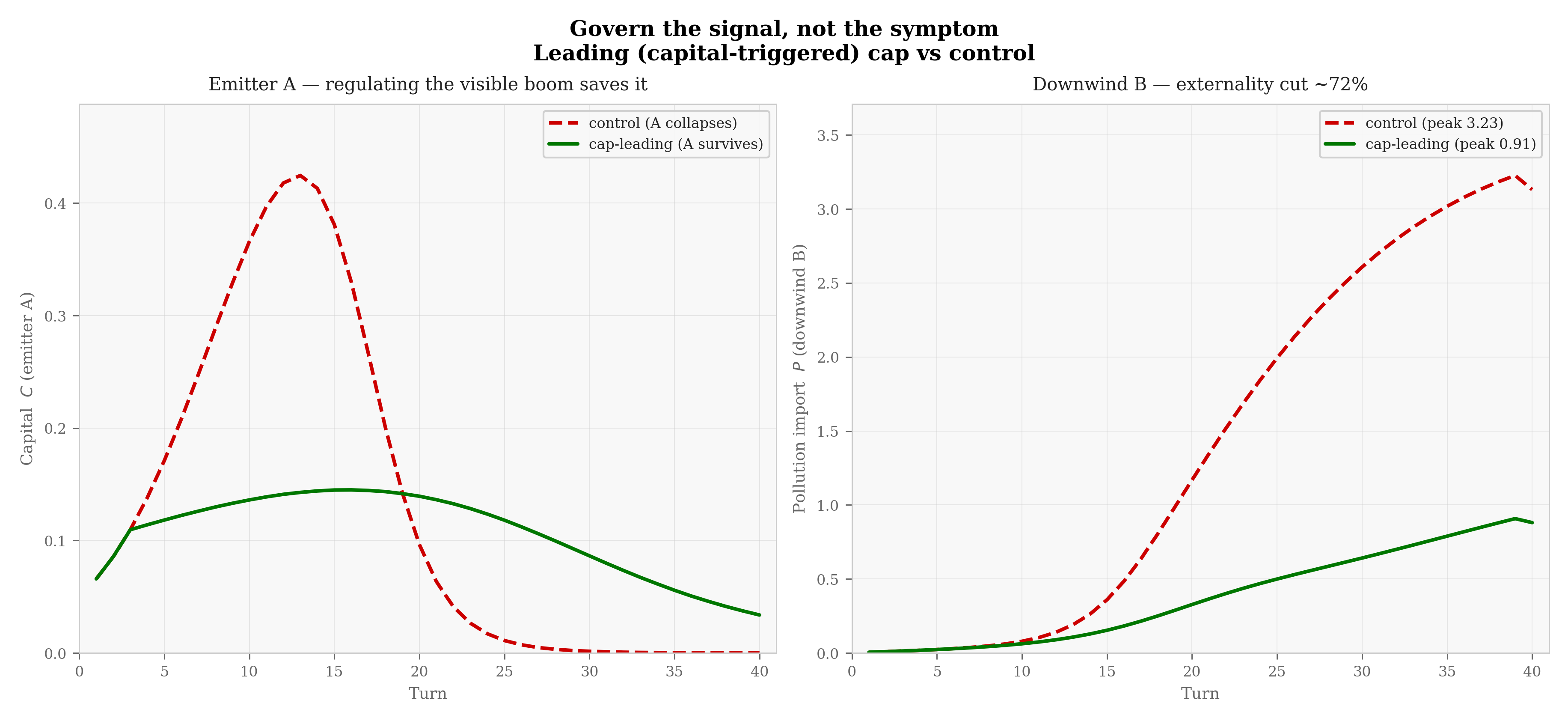
The fourth research paper escalates the question. Once several Bardi worlds are linked by a pollution flow, the question of which signal a regulator should act on becomes operational. Pollution is the visible damage; it is also the lagging tail of the industrial boom that already emitted it. The capital stock is the leading signal — visible to the regulator, but visible earlier.
The paper shows that capping the capital stock prevents the cascade and rescues the emitter from its own Seneca cliff: a Pareto-improving intervention, not a victim/polluter trade-off. The same cap armed on pollution arrives too late under every reasonable parameter setting (Brunelli 2026d). The headline is not “use this lever”; it is “act on the leading signal, whatever the lever is”.
2.7 The robustness routine
Each research finding above is reported with a small OFAT (one-factor-at-a-time) sweep around its claim, at N=5 seeds, with the swept parameter plotted on the x-axis and the headline outcome on the y-axis. The intent is modest: not to claim global generality, but to show the local neighbourhood in which the claim is stable. Where a finding bends, the paper reports the bend; where it survives, the sweep is in the appendix. The Seneca paper’s OFAT covers three parameters and one integration step, and reports the integration step as the edge case where the win-win softens.
2.8 What the project ships, beyond papers
Around the four research papers (BDPD\({}^0\) through BDPD\({}^3\)) the project ships a small constellation of derivative artefacts:
- Six blog essays that re-tell each headline finding in a literary register, suitable for circulation outside the academic loop.
- Two RevealJS pitch decks: one for the foundational platform, one for the full \({}^0\rightarrow{}^3\) arc.
- A ten-lecture mini-course, The Limits of Good Will, that uses the card game as the in-class anchor and the simulator as the homework substrate.
- An annotated bibliography rendered from the same BibTeX that feeds the papers, so that a reader can browse the references without the papers themselves.
The intent of the constellation is that no single audience has to enter through the heaviest door. A practitioner can read a blog post, attend a pitch, or play a card-game lecture; a researcher can read the relevant paper; a student can take the course; all four routes lead back to the same Arena underneath.