3 Four Vignettes
Each vignette follows the same structure: a research question, the minimal setup that isolates it, a result table comparing built-in agents against LLM players, and a reading that interprets the finding. Two additional vignettes — card game substrate validation (Appendix C) and noise/seed calibration (Appendix D) — are reported in the appendices.
3.1 Conventions
All four main vignettes (V1–V4) share the same logistic substrate: \(K = 100\), \(r = 0.10\), collapse threshold \(\theta = 10\), \(T_{\max} = 30\) for V1–V3 and \(25\) for V4. (Of the two appendix vignettes, V5 reproduces the cliff on the Forest of Humbaba card-game substrate; V6 reuses this same logistic substrate with observation noise enabled, as noted in their respective sections.) Each player carries a privateResource buffer of 30 so that small early sanctions do not bankrupt cooperators. Pacts, when used, are harvest_cap pacts with maximum harvest 2.0 per player per round; treaties are harvest_cap_per_arena_per_round with cap 8.0 per arena.
All results are reported as mean \(\pm\) standard deviation over \(N=5\) seeds (17, 23, 29, 31, 37) with observability noise \(\sigma = 0.03\) on commonsStock. The reason for the noise patch is given in Appendix A; for the reader’s purposes here, it suffices that without it the substrate is fully deterministic given the specification, and there is nothing for the seed sweep to surface.
Every LLM result uses DeepSeek-flash without chain-of-thought, temperature 0.4, the platform default prompt, and an archetype tag that nudges the system prompt toward either conservative or aggressive. The meta-agents (sanctioner, voluntary sanctioner, treaty enforcer) remain built-in throughout — they are policy surfaces, not behavioural units, and replacing them with LLM players would conflate two distinct questions.
3.2 V1 — Does the World abstraction leak across arenas?
Research question. When the same substrate that produced the single-arena cliff is embedded inside a World together with nine other arenas, does the cliff arena still collapse, and do the other nine arenas remain bit-identical to a free-running single-arena baseline?
BDPD\(^1\) (Brunelli 2026) established that a single aggressive player in an otherwise conservative arena produces a sharp 1-to-0 collapse transition by turn \(T \approx 24\), with \(S_{\text{final}} = 4.4 \pm 0\) when the run is fully deterministic. That finding operated on a single arena; the nested substrate raises the question of whether the result holds when the cliff arena is one of many running in parallel.
Setup. Ten arenas, six players each. Arena #0 hosts one aggressive plus five conservative built-in players; arenas #1–9 host six conservatives. No Links, no Treaties, no meta-agents — the World here is only the scheduler. Run for \(T_{\max} = 30\).
Result.
| Metric (N=5) | Arena #0 (cliff) | Arenas #1–9 (control) |
|---|---|---|
| Turns until close | 23.4 \(\pm\) 0.5 | 30 (capped) |
| Final stock | 7 \(\pm\) 2 | 58.5 \(\pm\) 0.4 (mean per arena) |
| Survivors at \(T = 30\) | 0 (5/5 collapsed) | 9/9 (5/5 seeds) |
| Cross-arena variance | — | \(\sigma\) over 45 arena-seeds = 1.0 |
The cliff arena collapses in 5/5 seeds, with a tight spread on the timing (23–24 turns) but a meaningful spread on the depth (\(S_{\text{final}}\) ranges 4.0–9.8). All 45 conservative arena instances survive to the cap with final stocks within ~1% of each other; no seed produces a cross-arena artefact.
Reading. The qualitative single-arena finding migrates cleanly onto the nested substrate: embedding the cliff arena into a 10-arena world neither rescues it nor destabilises its conservative neighbours. Two cautions nevertheless emerge. First, the precise depth at which the collapsed arena settles is sensitive to early-turn noise; this is the kind of quantitative detail that any campaign-scale follow-up will need to report as a distribution rather than a point value. Second, the survivors’ mean stock (58.5) is below the noise-free equilibrium stock (60.0) by an amount consistent with the noise budget;1 the substrate is unbiased but not point-identical to the deterministic case.
V1 also establishes the baseline for a pattern that will recur throughout: built-in agents are rule-bound — they execute a fixed strategy regardless of institutional context — so the World abstraction produces no behavioural response beyond what the strategy parameters dictate. Whether governance does produce a response, and in which direction, will depend on the agent architecture. V2–V4 test this by comparing rule-bound heuristics against signal-adaptive LLM agents under progressively stronger institutional designs.
V1 closes the isolation question. The remaining vignettes turn on the opposite case, where arenas are not isolated: V2 keeps the policy inside one arena but changes who the sanctioner is, V3 adds a treaty that constrains multiple arenas at once, and V4 routes pact violators out of their arena into a junk arena. The fact that V1 sees no spurious coupling licences reading those later results as genuine consequences of the institutional structure, not of the substrate.
3.3 V2 — Reflexive vs voluntary sanctioner: does the ladder pay?
Research question. Given a pact-violating defector (the mule of BDPD\(^0\): a single aggressive agent whose strategy is to harvest above the pact cap) and a meta-agent who can sanction, does relaxing the sanctioner’s response policy from reflexive to voluntary (act only when the commons is at risk, and only after repeat violations) preserve the ladder of sanction efficiency, deterrence, and survival that single-arena governance produced?
Yoon-style voluntary sanctioning (Yoon and Armsworth 2025) suggests an efficiency ladder as the sanctioner moves from reflexive to voluntary-with-stock-gate to voluntary-with-repeat-gate; the built-in baseline below (\(N = 5\), see Result table) reproduces it (\(1.00 \to 0.93 \to 0.86\)), with defector wealth absorbing the trade-off (\(34 \to 40 \to 46\)) and survival held roughly invariant (21–19 turns). The question here is whether that ladder is robust in two senses: across seeds, and across the class of players being sanctioned.
Setup. One arena, five player-role agents (4 conservative + 1 aggressive defector) plus a built-in meta-agent (role: 'meta') in three configurations: \(A\) reflexive sanctioner, \(B\) voluntary with stock-ratio gate \(\le 0.5\), \(C\) voluntary with stock gate \(\le 0.5\) plus repeat threshold 2. Pact maximum harvest 2.0, sanction amount 3.0, \(T_{\max} = 30\). Throughout V2, efficiency denotes the ratio of sanctions to violations (1.0 = every violation is sanctioned), computed per seed and averaged over the seeds with at least one violation.
Result (built-in N=5).
| Cell | Turns | Violations | Sanctions | Efficiency | Defector wealth |
|---|---|---|---|---|---|
| \(A\) reflexive | 21.0 (flat) | 16 (flat) | 16 (flat) | 1.00 (flat) | 34.0 (flat) |
| \(B\) voluntary50 | 20.0 (flat) | 15 (flat) | 14 (flat) | 0.93 (flat) | 40.2 (flat) |
| \(C\) voluntary50, repeat 2 | 19.0 (flat) | 14 (flat) | 12 (flat) | 0.86 (flat) | 45.6 (flat) |
The single-arena ladder reproduces exactly at \(N = 5\) with noise on: the built-in defector is fully cap-bound and the conservative agents do not deviate, so seed variation has no behavioural channel through which to enter. The ladder is robust by construction.
Result (LLM N=5). The same configuration with five DeepSeek players per cell tells a markedly different story:
| Cell | Turns | Violations | Sanctions | Efficiency | Defector wealth |
|---|---|---|---|---|---|
| \(A\) reflexive | 30 \(\pm\) 0 | 3 \(\pm\) 3 | 3 \(\pm\) 3 | 1.00 \(\pm\) 0.00 | 80 \(\pm\) 11 |
| \(B\) voluntary50 | 30 \(\pm\) 0 | 2 \(\pm\) 3 | 1 \(\pm\) 2 | 0.86 \(\pm\) 0.20 | 87 \(\pm\) 6 |
| \(C\) voluntary50, repeat 2 | 21 \(\pm\) 9 | 17 \(\pm\) 4 | 10 \(\pm\) 4 | 0.60 \(\pm\) 0.13 | 55 \(\pm\) 14 |
Three reversals stand out. First, cells \(A\) and \(B\) no longer need the sanctioner to fire in volume: visible reflexive deterrence is enough to keep an LLM defector near-compliant (3 violations in 30 turns vs 16 in 21 turns for the built-in case). Second, cell \(C\) does worse with LLM players than the built-in defector managed, because the repeat-threshold gates the first two violations and the LLM agents read the absence of an immediate sanction as licence to escalate; survival becomes erratic (\(21 \pm 9\) turns against a flat 19 for the built-in defector), with three of the five seeds cliffing early (\(T = 12, 14, 17\)) while the other two reach the cap. Third, the defector-wealth ladder turns non-monotone: under LLM players the defector earns most under the intermediate policy (\(87\) in \(B\)) and least under the most lenient one (\(55\) in \(C\)), because in \(C\) the commons collapses and there is nothing left to harvest — even the weakest enforcement leaves the defector poorer than the strongest, reflexive policy (\(80\) in \(A\)).
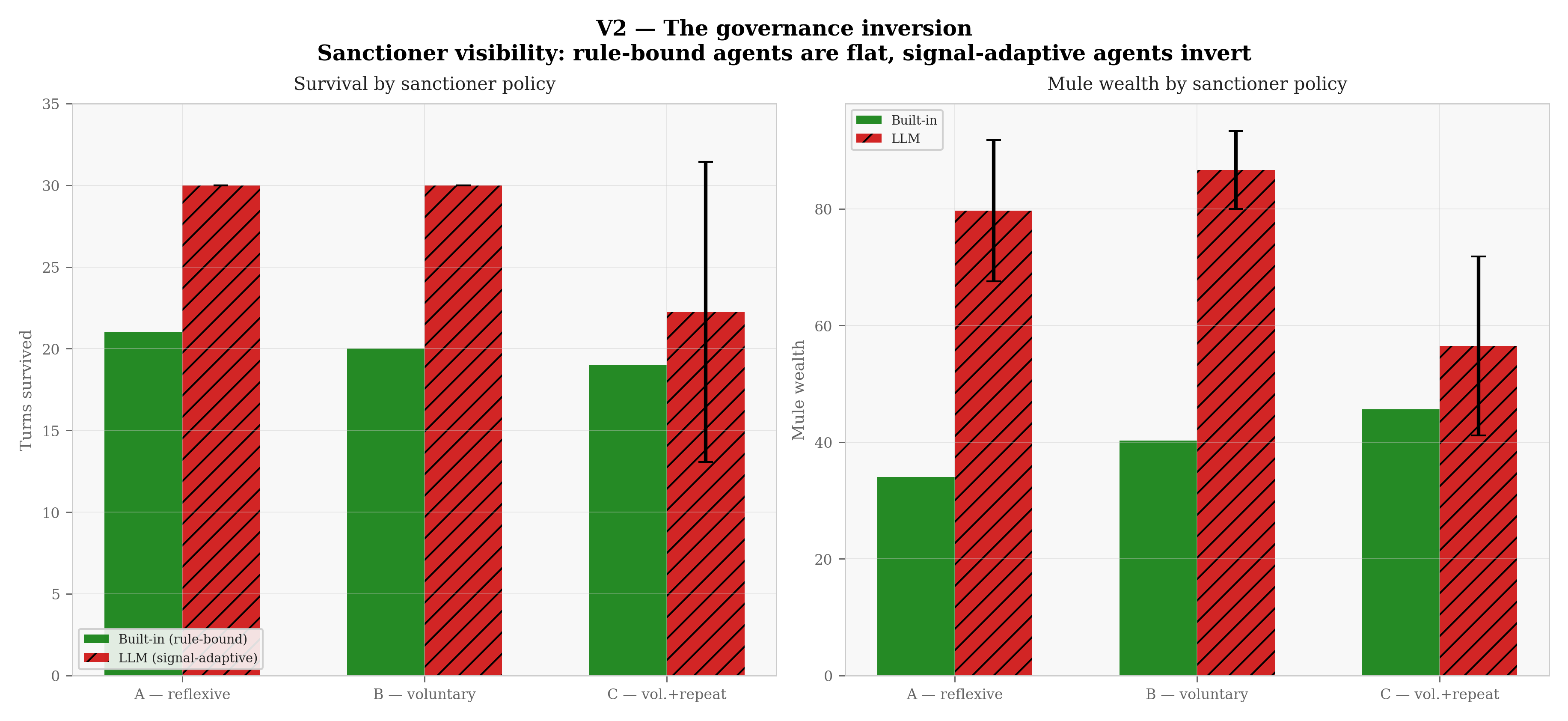
Reading. The single-arena efficiency ladder is an artefact of built-in agents’ deterministic cap-binding — harvesting exactly at the pact maximum, regardless of the sanctioner’s policy (Figure 3.1). LLM players turn the ladder into a compliance threshold: visible enforcement of any strength is sufficient; absent or delayed enforcement licenses cascade. The substrate did not lie, but its behavioural lessons are class-dependent in a way worth taking seriously.
V2 establishes that arena-level policy can behave differently depending on who plays under it: rule-bound agents are indifferent to the sanctioner’s visibility, while signal-adaptive agents decode the institutional signal and modulate their response accordingly. V3 raises the same question one level up: at the world-level treaty surface, does the signal-adaptive LLM defector push harder against the cap than the rule-bound built-in defector did?
3.4 V3 — World-level treaty enforcer: how often does it fire?
Research question. When a world-level enforcer monitors a treaty cap that spans three arenas, and when one arena hosts a defector who is responsible for most of the cap-bursting, how often does the enforcer need to fire to keep the system stable, and who pays the cost?
The platform ships a TreatyEnforcerAgent (world-scope meta-agent) demonstrated in a one-shot built-in test: a single firing at round 4 (when aggregate harvest in arena \(A\) reached 8.20 against the cap of 8.00) distributed an 18-point wealth shock across the five \(A\) players, after which the defector’s harvest pressure remained moderated for the rest of the run. The question is whether a single firing remains representative when the defector is an LLM, and how the cost of enforcement scales with the agent’s persistence.
Setup. Three arenas inside one World. Arena \(A\) has five players (4 cons + 1 defector); arenas \(B\) and \(C\) have three conservative players each. A global treaty harvest_cap_per_arena_per_round caps each arena at 8.0 per round. In the on cell, a treaty_enforcer meta-agent applies a collective wealth_shock with sanction factor 0.9 to the offending arena’s players when the cap is breached. \(T_{\max} = 30\).
Result (built-in vs LLM, \(N=5\)).
| Metric | built-in off | built-in on | LLM off | LLM on |
|---|---|---|---|---|
| Surv. arena \(A\) (turns) | 17 (flat) | 18 (flat) | 24 \(\pm\) 9 | 26 \(\pm\) 6 |
| Final \(S\) arena \(A\) | 6.4 \(\pm\) 1.0 | 6.2 \(\pm\) 0.5 | 24 \(\pm\) 18 | 19 \(\pm\) 11 |
| Enforcer firings | 0 (flat) | 1.0 (flat) | 0 (flat) | 2.4 \(\pm\) 0.9 |
| Total shocked wealth | 0 | 18 | 0 | 38 \(\pm\) 14 |
| Sum wealth \(A\) (5 players) | 258 | 241 | 258 \(\pm\) 8 | 226 \(\pm\) 20 |
The headline shifts twice. First, without the enforcer attached, the built-in arena \(A\) collapses at \(T = 17\) in all seeds while LLM arena \(A\) survives to the cap in three of five seeds (the other two cliff at \(T = 14\)). The LLM cohort self-moderates enough to avoid collapse on the strength of pact visibility alone — there is no formal cost on cap-bursting in off, only the social information of the pact itself. Second, with the enforcer attached, the LLM defector pushes the cap repeatedly (2.4 firings on average against the built-in defector’s 1.0), each firing absorbs ~15 wealth points, and the total wealth penalty roughly doubles relative to the built-in case (38 \(\pm\) 14 vs 18, a \(\sim 2.1\times\) ratio whose seed-level spread is too wide for a strict claim at \(N = 5\)).
Reading. The central contrast is architectural, not institutional. A built-in defector does not learn from an enforcement shock — it simply resumes cap-bound harvesting once the penalty clears, so a single firing suffices and the treaty enforcer becomes a background guarantee. An LLM defector treats the shock as information about where the regulatory boundary is and probes again, turning a one-shot deterrence into a recurring enforcement cycle. The institutional design question therefore shifts from will the enforcer fire? to will the LLM violator eventually accept the cap, or does probing continue indefinitely? Within this 30-turn horizon the cost appears bounded — 2.4 firings absorbing a total of 38.2 wealth units — and the downstream arenas \(B\) and \(C\) are shielded: their wealth deltas of \(+3.6\) and \(+1.2\) sit within cross-seed sampling noise (no inter-arena resource link carries the shock), consistent with the enforcement cost falling on the emitting arena alone.
V3 establishes that the world-level meta-agent surface remains load-bearing under LLM players, but at a multiplied cost — the signal-adaptive defector reads the enforcement shock as information about where the boundary is, then probes again, turning a one-shot intervention into a recurring expense. V4 takes the most coercive step: instead of cycling sanctions through the violator, the institution removes them — and asks whether removal stays type-pure or triggers behavioural contagion among the remaining signal-adaptive agents.
3.5 V4 — Coercive exclusion: pure cluster or behavioural contagion?
Research question. When pact-violating players are migrated to a designated junk arena, does the junk arena fill up with pre-marked aggressors only, or do conformist conservatives follow them in?
The built-in exclusion test shipped a clean result: three main arenas, each with a defector who flips to aggressive at a staggered turn, plus one shared junk arena receiving any pact violator. Across 5 seeds, the on cell produced three excludes, junk composition 3 mules + 0 conservatives (purity 1.00), and survival of all three main arenas to the cap. The institutional story was “junk arena = cluster of aggressors”, and the governance implication was that exclusion acts as a clean sorting mechanism on pre-determined behavioural types.
Setup. Three main arenas of five players each (4 cons + 1 LLM defector from \(T = 0\); we drop the staggered strategy flip since LLM archetype tags fix behaviour at spawn time). One shared junk arena. on cell adds an exclude perturbation on each main, triggered by pact_violation, with payload pointing to the junk arena. \(T_{\max} = 25\).
Result (built-in vs LLM, \(N=5\)).
| Metric | built-in on | LLM off | LLM on |
|---|---|---|---|
| Total excludes | 3.0 (flat) | 0 (flat) | 2.2 \(\pm\) 0.8 |
| Junk size at \(T_{\max}\) | 3 | 0 | 2.2 \(\pm\) 0.8 |
| Junk purity (defectors / total) | 1.00 | — | 0.6 \(\pm\) 0.3 |
| Survival of all 3 mains | 5/5 | 1/5 | 5/5 |
| Mean wealth per main | 213.0 | 252.6 | 212.5 |
The headline finding is the purity drop. In three of the five seeds (seeds 17, 29, 31) the junk arena contains not only the LLM defector but one or two conservative LLM players who breached the pact alongside the defector and were swept up by the same exclude rule. The two pure seeds (23, 37) place either two of the three defectors in junk together (seed 23) or only a single defector (seed 37). The mean purity is \(0.6\) with standard deviation \(0.3\) — a wide enough spread that the institutional story is no longer “exclusion sorts pre-marked types” but “exclusion captures the locally defecting bloc, whatever its prior labels”.
A second, milder, finding parallels V3. In the off cell — no exclusion, only the pact’s social information — any given main arena still survives in roughly 3 of 5 seeds (10 of 15 arena-instances), where built-in heuristics always cliffed, yet all three survive jointly in only 1 of 5. The LLM defector’s signal rarely forces a single arena to collapse on its own; it is the institution that carries all three across together.
Reading. Under LLM players, exclusion is not type sorting — a clean removal of pre-marked aggressors — but behavioural quarantine: it captures whoever is actively defecting when the rule fires, including conformists who breached the pact alongside the defector (whether through independent decision noise or social transmission is precisely the open question separated below). The perturbation still works in its primary function: 5 of 5 seeds save all three main arenas at a wealth cost (~16%) consistent with the built-in finding. But the institutional guarantee changes from ‘junk arena fills with aggressors’ to ‘junk arena fills with the current defecting coalition’, which is a less predictable object to design around.
Two causal stories are compatible with the purity drop, and the present \(N = 5\) sweep cannot separate them — both remain hypotheses to be tested, not observed mechanisms. Passive spillover: each LLM cooperator defects with a small independent probability unrelated to the defector — the purity drop is statistical noise on a low base rate, and breaking the social channel would not change the result. Active contagion: cooperators observe the defector’s visible extraction and update toward defection themselves — the purity drop is a social signal propagating through the arena, and hiding the defector’s harvest record would suppress it. This mechanism would be consistent, by analogy, with the normative conformity bias documented in dyadic LLM judgement tasks (Bito et al. 2026) and with the recommender-driven polarisation observed in opinion-dynamics LLM simulations (Bojić et al. 2025); both literatures demonstrate that LLMs adjust toward a locally dominant behavioural signal, though the original settings differ from the commons-extraction setting studied here. The human-subject analogue is the experimentally demonstrated emergence of tipping points in social conventions, in which a sufficiently visible minority can flip the majority’s behavioural equilibrium (Centola et al. 2018). Analytical CPR models with heterogeneous risk perception under regime shift predict similar non-monotonic adjustments (Mavi and Quérou 2021). Passive spillover predicts no association between the defector’s breach timing and conformist breach timing; active contagion predicts a lag. Distinguishing between the two is the single most informative cut a campaign-scale follow-up could buy (see Road B in Chapter 5).
V4 closes the four-vignette arc with the strongest qualitative inversion of the survey: the LLM compositional finding contradicts the built-in finding’s direction, not just its magnitude. Across all four vignettes, the same pattern holds — rule-bound agents are invariant to institutional design, while signal-adaptive agents respond in both directions depending on the signal’s strength and timing. Chapter 4 draws the cross-cutting implications.
With observability noise \(\sigma = 0.03\) on a nominal stock \(S \approx 60\) over \(T = 30\) turns, the expected cumulative bias from agents reacting to noisy observations is \(\sim 30 \cdot 0.03 \cdot 2 \approx 1.8\) units within a \(2\sigma\) envelope. The observed shortfall \(60.0 - 58.5 = 1.5\) sits inside that envelope.↩︎