4 Robustness
Seneca is a pure ODE: the seed is inert (seed 17 \(\equiv\) seed 42, byte-identical), so performing a multi-seed “N=5” sweep would produce five copies of one trajectory (this determinism holds because both the ODE engine and the RCP agents are purely arithmetic; adding observation noise would require multi-seed sampling). Robustness is instead structural — a one-factor-at-a-time (OFAT) sweep over dt, \(k_1\), baseFraction, and linkRate (5 levels each, others held at the cascade baseline), each of three claims reported as X/5 (Table 4.1):
| factor (5 levels) | A: reactive-too-late | B: leading win-win | C: monotone ladder |
|---|---|---|---|
dt \(\in\) {2, 2.5, 3, 3.5, 4} |
5/5 | 3/5 | 5/5 |
| \(k_1\) \(\in\) {.06,.08,.10,.12,.14} | 5/5 | 5/5 | 5/5 |
baseFraction \(\in\) {.003,.004,.005,.006,.007} |
5/5 | 5/5 | 5/5 |
linkRate \(\in\) {.2,.3,.4,.5,.6} |
5/5 | 5/5 | 5/5 |
Operationally, “emitter survives” means capital never falls below 10 % of its peak value — the Seneca cliff is steep enough that the threshold choice is insensitive, though for the low-plateau regime under cap-leading the margin is narrower. “Downwind B recovers” means B’s peak capital improves relative to the control (i.e. recoverB > 0); B may still eventually collapse, but later and from a higher peak. The OFAT design tests one factor at a time; joint interactions (e.g. high dt combined with high \(k_1\)) are not captured and would require a factorial design.
Claims A and C are ironclad (20/20). Claim B fails only on dt (at \(dt \geq 3.5\)), and only its “saves the emitter” sub-clause — “downwind B recovers” holds 5/5 even at dt = 4. The partial win-win is more robust than the full win-win.
4.1 When sampling slows: graceful degradation, not failure
At what governance cadence does the leading indicator lose its advantage? It never does: even at the coarsest sampling tested (\(dt = 4\)), cap-leading still strictly dominates every reactive baseline. What degrades is who is saved — the emitter loses protection at \(dt \geq 3.5\), but the downwind victims remain protected throughout (the “win-some” regime: downwind saved, emitter sacrificed). The subsections below detail the mechanism.
The dt sweep tells a richer story than a binary 3/5. Across \(dt \in \{2, 2.5, 3,
3.5, 4\}\), cap-leading’s downwind recovery recoverB grows monotonically (10.0% \(\to\) 14.5% \(\to\) 19.7% \(\to\) 20.6% \(\to\) 27.8%), while reactive cap-on-pollution and levy-on-pollution remain pinned at exactly 0% throughout. What changes at \(dt \geq 3.5\) is not whether leading-on-capital does anything — it does, more and more — but who it saves: the downwind arenas keep being protected; the emitter itself is no longer rescued.
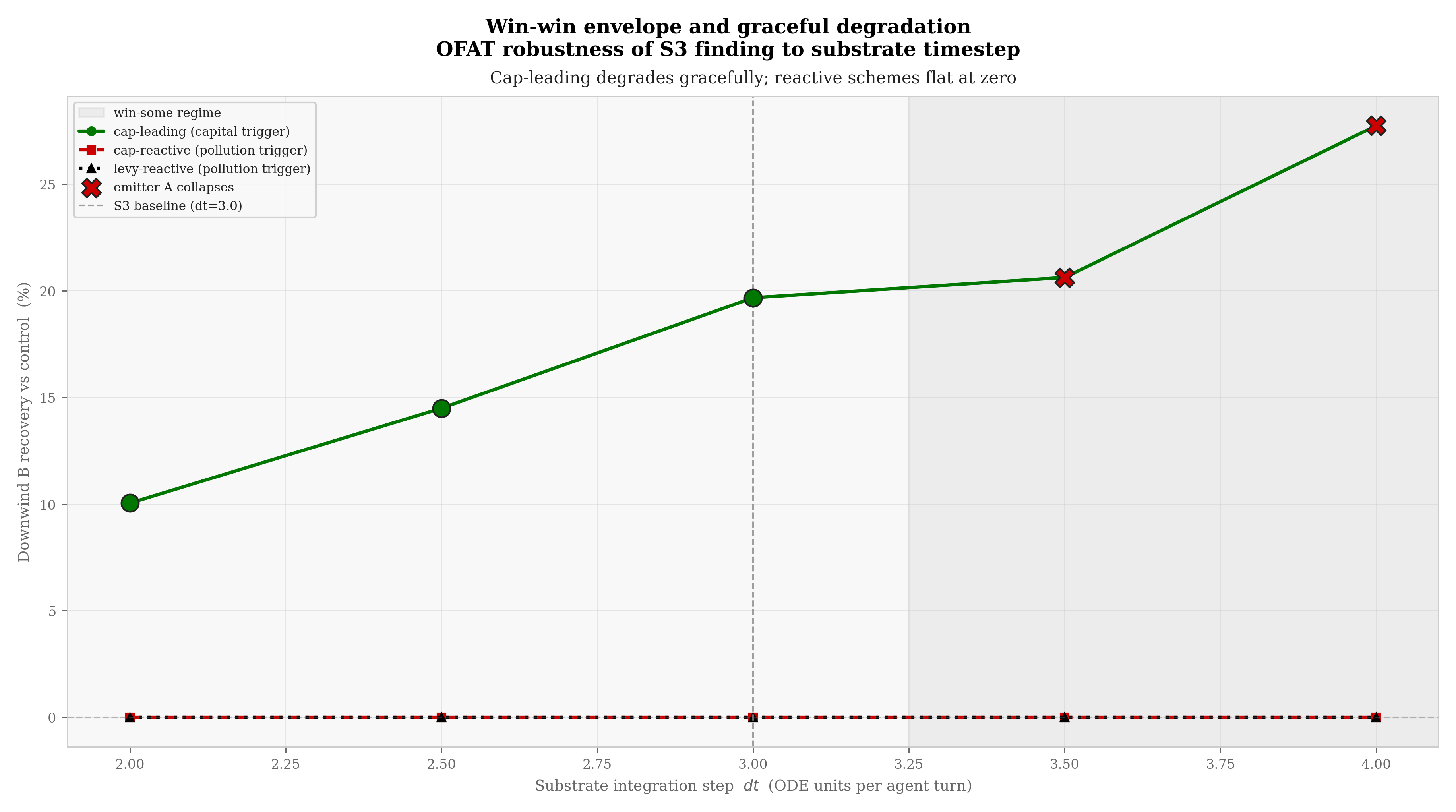
dt; emitter A survives at \(dt \leq 3\) (green markers) and collapses at \(dt \geq 3.5\) (red \(\times\)). Both reactive schemes stay flat at 0% across the full range. The shaded region marks the “win-some” regime where cap-leading still strictly Pareto-dominates the reactive baselines.
Two control checks rule out trivial explanations of the rising curve (Figure 4.1). First, the denominator control.B.peak (the reference against which recoverB is normalised) itself grows with dt (0.076 \(\to\) 0.146), so the ratio is not inflated by a shrinking control — the absolute peak of B under cap-leading also grows (0.083 \(\to\) 0.186). Second, in ODE-time (not turn-count), B’s collapse under cap-leading occurs at a near-constant phase across all dt (\(\approx\) 76–84 ODE units), suggesting the regulator confers downwind a fixed “grace period” in substrate time independent of the sampling cadence.
The asymmetry is mechanistic, not numerical. Euler integration uses microDt = dt / 10, so even at dt = 4 the per-microstep Jacobian magnitude stays well inside the stability region; the ODE does not blow up. Rather, the governor observes state after the ODE integration and its intervention takes effect only at the following turn; this one-turn latency means capital grows unthrottled for one full dt before the cap engages. At dt = 3.0 with \(k_1 = 0.10\) and \(C \approx 0.10\), the unthrottled growth is \(\Delta C \approx k_1 \cdot R \cdot C \cdot dt \approx 0.03\); at dt = 4.0 it rises to \(\approx 0.04\). When dt is large enough, capital can deplete the emitter’s resource base past the point of recovery during this latency window — even though the same intervention still arrives in time to cap the pollution leaking downwind.
This is structurally a rate-induced effect in the sense of Lohmann et al. (2021): the cascade reaches the emitter not because a static bifurcation threshold has been crossed, but because the relative rate of substrate dynamics versus governance sampling has. The “win-win \(\to\) win-some” boundary at \(dt \geq 3.5\) behaves as a soft tipping point (Lohmann et al. 2021, sec. 3.1) — no hard threshold in dt, just a smooth degradation in which the regulator progressively fails to track the moving equilibrium of capital. Notably, Klose et al. (2021) explicitly exclude rate-induced effects from their taxonomy of tipping cascades; the present finding occupies that gap on the governance-rate axis, complementary to Lohmann et al.’s forcing-rate analysis: where they study how fast an external driver can push a coupled system, we study how slowly a regulator can sample a leading signal before it stops protecting the source.
The present finding is conservative: the operating envelope of cap-leading is \(dt \leq 3\) for full win-win, and it degrades gracefully beyond that, never collapsing to win-none. The failure mode and its broader implications are discussed in Chapter 6.