2 The BDPD Approach
The BDPD framework rests on a methodological wager: that the same phenomena — irreversible collapse, strategic extraction, and compounding inequality — can be studied simultaneously on two complementary substrates, each illuminating what the other cannot. The first instrument is a computational multi-agent platform (the BDPD Arena) that allows exhaustive parametric sweep over agent composition, resource dynamics, and information structure. The second is a tabletop card game (The Forest of Humbaba) that translates every platform mechanism into a tangible object, enabling LLM players (and, in future work, human participants) to encounter the same strategic pressures in an embodied, social setting. Neither instrument alone is sufficient: the platform produces statistical regularities but no intuition; the card game produces intuition but no statistics. Together they form a dual-mode laboratory in which findings on one substrate can be tested for robustness on the other. The following sections describe each instrument in turn; the experimental protocol common to both is detailed in §3 (Section 3.1).
2.1 The BDPD Arena: A Configurable Multi-Agent Laboratory
The study of common-pool resource dynamics poses a fundamental methodological challenge: analytical models can characterise equilibria, but they struggle to capture the combinatorial complexity that arises when heterogeneous agents, stochastic thresholds, and temporal asymmetries interact simultaneously. The BDPD Arena is a multi-agent simulation platform that orchestrates games in discrete time, designed to isolate and recombine these dynamics in a controlled, reproducible environment. Rather than assuming away inconvenient complexity, the Arena treats agent heterogeneity, Knightian uncertainty about collapse thresholds, and wealth-driven power asymmetries as first-class experimental variables.
2.1.1 Core Game Engine and Commons Dynamics
At the heart of the Arena lies a pluggable scenario engine modelling competition for the common-pool resource. This paper focuses on the logistic growth model; let \(S_t\) be the resource stock, \(K\) the carrying capacity, and \(r\) the regeneration rate. The stock evolves according to:
\[ S_{t+1} = \max\left(0, \min\left(K,\ (S_t - H_t) + r(S_t - H_t)\left(1 - \frac{S_t - H_t}{K}\right)\right)\right), \]
where \(H_t\) is the total harvest and regeneration is applied to the post-harvest residual \(S_t - H_t\) (harvests are rationed proportionally if demand exceeds supply). Default parameters (\(r = 0.12\), \(K = 150\)) are chosen as a representative baseline that produces 20–30 turn games with a non-trivial sustainability window; sensitivity to \(r\) is explored systematically in P2–P3 (§3). Harvest capacity scales with accumulated wealth as \(1 + 0.05 \times w_{i,t}\), modelling the compounding advantage of early extractors — a stylised form of the “rich get richer” dynamic identified by Dayton-Johnson and Bardhan (2002).
The logistic model provides a well-understood, symmetric baseline. Two mechanisms extend it with stochastic and incentive dynamics; a third — the perturbation engine — enables systematic testing of environmental shocks. The structural Seneca cliff (asymmetric collapse driven by capital accumulation and pollution feedback) is a property of Bardi’s (2017) three-variable ODE, implemented as the seneca engine and deferred to future sweeps (see Section A.1).
Hidden Reserve and the Forest Die (optional engine layer). The platform additionally supports a stochastic collapse layer, enabled by default in the card game and configurable in the Arena via useHiddenReserve (off by default; off for all P-sweeps reported in §3 — the platform results in this paper are deterministic). When active, the model maintains a hidden reserve \(R_t\) unknown to agents. When the visible stock is exhausted and agents still attempt to harvest, each excess unit triggers a roll of a six-sided die — the Forest Die. On a successful roll (\(\leq 4\) by default), one unit is drawn from the reserve; on a failure (5–6), the commons collapses immediately and irreversibly. This is BDPD’s mechanic-level instantiation of the threshold uncertainty that Santos and Pacheco (2011) identify analytically as central to collective-risk dilemmas — they model failure as a probabilistic loss when the minimum contribution \(M\) is not met; we render that uncertainty concrete as a hidden reserve plus die-roll, replacing a fixed gate with Knightian uncertainty agents cannot price until the die is cast. In the platform sweeps of this paper the Hidden Reserve is disabled and the collapse gate is purely the threshold described above; the card game (§2.2) is the substrate on which the Forest Die is empirically exercised, and the mechanism is carried forward unchanged as the physical Forest Die — making the stochastic risk visible and tangible at the table.
Regen Shocks and Perturbation Resilience. The logistic baseline is symmetric by construction — resource dynamics respond proportionally to perturbations in either direction. Structural asymmetries, such as the Seneca effect (slow growth, rapid collapse), are not a property of this model. The perturbation engine therefore poses an empirical question to the logistic model: does an asymmetric response emerge from the interaction between environmental shocks and the strategic context, even in a symmetric baseline?
Regen shocks multiply \(r\) by a configurable factor at a specified turn (negative shocks: factor \(< 1\); positive shocks: factor \(> 1\)). The experimental result (P10, Appendix B4) is itself instructive: asymmetry emerges, but inverted relative to the Seneca direction — positive shocks help more than equally-sized negative shocks hurt. The mechanism is strategic, not structural: the aggressive agent has already pre-depleted the commons before the shock arrives, so negative shocks compound an already-stressed trajectory (their marginal damage is bounded), while positive shocks add regeneration that compounds over the remaining turns. Removing the aggressor (B4) restores near-symmetric response. Commons shocks (step changes to \(S_t\) directly) complement regen shocks for testing instantaneous depletion events.
Gate+Rank Victory. The game is won only if the resource survives a configurable collapse threshold: by default \(S_\text{final} > 10\) (approximately 6 % of \(K = 150\)), at which point logistic regeneration becomes negligible and recovery is impossible. If the gate passes, agents are ranked by wealth; if it fails, all payoffs are zero. This two-stage function creates genuine tension between individual accumulation and collective preservation. The threshold is a tunable parameter (threshold in the model spec); a complementary, stochastic gate condition activates when the Hidden Reserve layer is enabled (see next paragraph).
2.1.2 Turn Order, Observability, and the Mule
Three pluggable schedulers study how sequence and power asymmetry affect outcomes: simultaneous (baseline, closest to continuous-time differential game), sequential random (information cascades), and wealth-weighted (richer agents act first, modelling regulatory capture (Dal Bó 2006)). Observability is configurable: Gaussian noise can be added to the stock signal, and resolution can be set to exact or bucketed values, directly addressing RQ3.
The perturbation engine also supports strategy override, nicknamed “The Mule” after the character in Asimov’s Foundation — an unpredictable structural agent whose appearance breaks models built on the assumption of stable populations. In the Arena, The Mule dynamically replaces an agent’s decision function mid-game: a conservative agent suddenly switches to aggressive extraction at a configurable turn. This tests the structural fragility of otherwise stable commons: can a well-functioning cooperative arrangement survive a single, well-timed defection?
2.1.3 Mapping to Theoretical Foundations
| Theoretical Concept | BDPD Implementation |
|---|---|
| Stochastic Collapse (BDPD’s mechanic-level rendering of the threshold uncertainty analysed by Santos and Pacheco (2011)) | Hidden reserve + Forest Die (optional Arena layer; off for the P-sweeps in §3). Extends the fixed threshold gate with Knightian uncertainty when enabled. Always active in the card game, where it becomes the physical Forest Die. |
| Tragedy of the Commons (Hardin 1968) | Individual harvest decisions aggregated as \(H_t\); Gate+Rank victory aligns private and collective incentives only if the gate passes. |
| Wealth Inequality (Dayton-Johnson and Bardhan 2002) | Harvest capacity scales with wealth (\(1 + 0.05 \times w_{i,t}\)). Asymmetric initial endowments. Welfare score \(\bigl((1-G)\bar{w}\bigr)\) and Gini tracked per turn — a Sen-type aggregate balancing collective efficiency and equality. |
| Polycentric Governance (Vasconcelos et al. 2015) | Pool size is a configurable, swept parameter (P3–P4: \(N\) = 2–20); nested governance structures are not implemented (future work; see §4 Ostrom mapping). |
| Cooperative Dependency (Owusu et al. 2019) | Agent composition (ratio of aggressive to conservative) is a primary experimental variable. |
| Seneca Effect (Bardi 2017) | Structural Seneca cliffs (asymmetric collapse from capital/pollution feedback) are a property of the Bardi seneca engine; sweeps are deferred to future work. In the logistic baseline studied here, regen shocks probe perturbation resilience in a symmetric model. The asymmetry that does appear in P10 emerges from the aggressive agent’s strategic pre-depletion, not from any intrinsic asymmetry of the resource model (confirmed by B4). |
Figure 2.1 shows the resulting dashboard for a representative four-agent run in which an aggressive LLM agent drives the commons to the collapse threshold; Figure 2.2 decomposes the same run into per-agent harvest and wealth trajectories, making the capacity feedback (\(1 + 0.05 \times w\)) and the reactive < conservative effect (formally introduced in Section 3.4) visible.
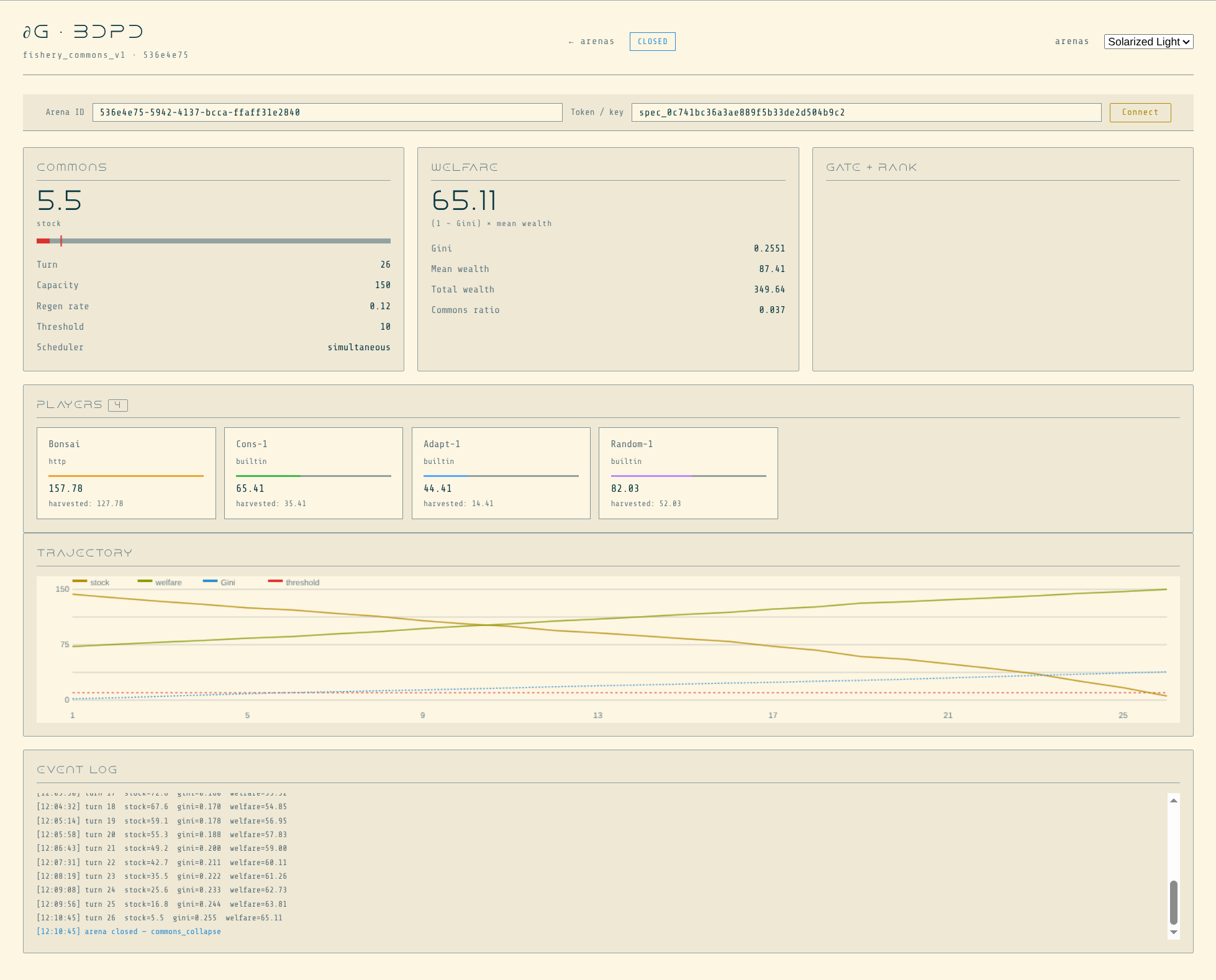
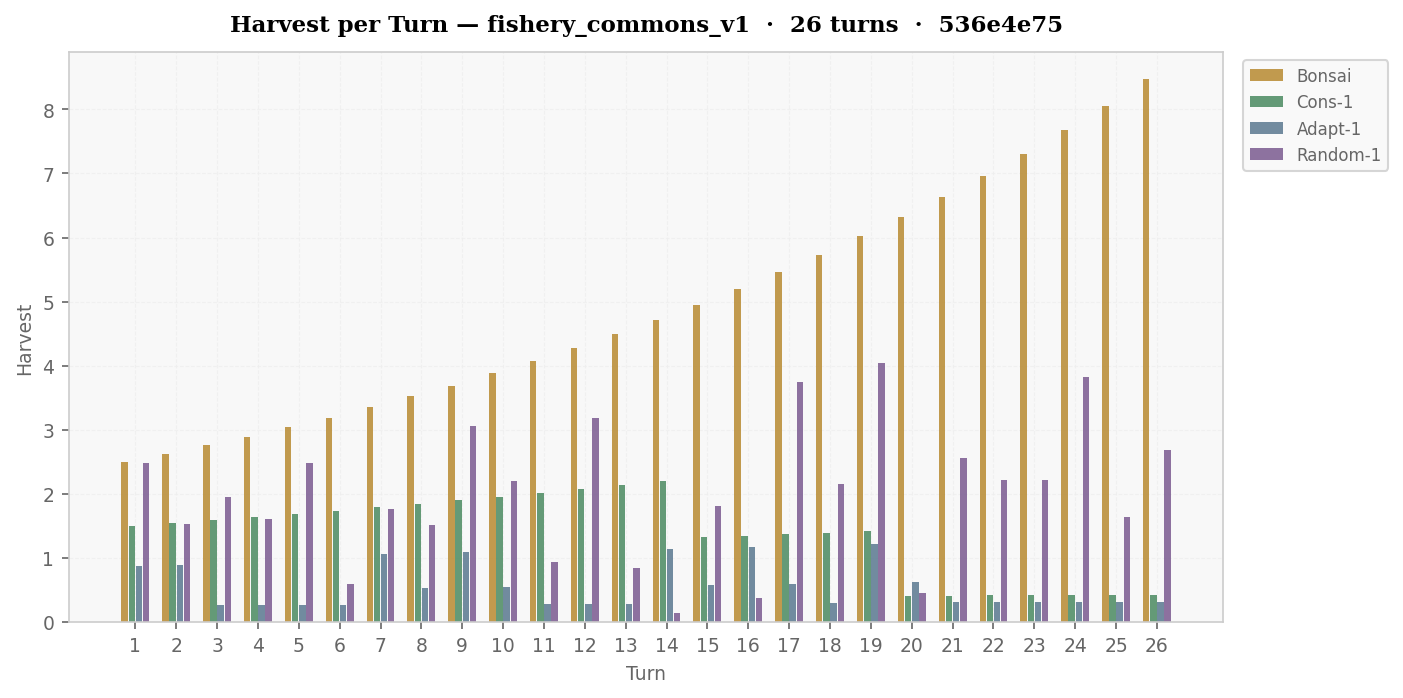
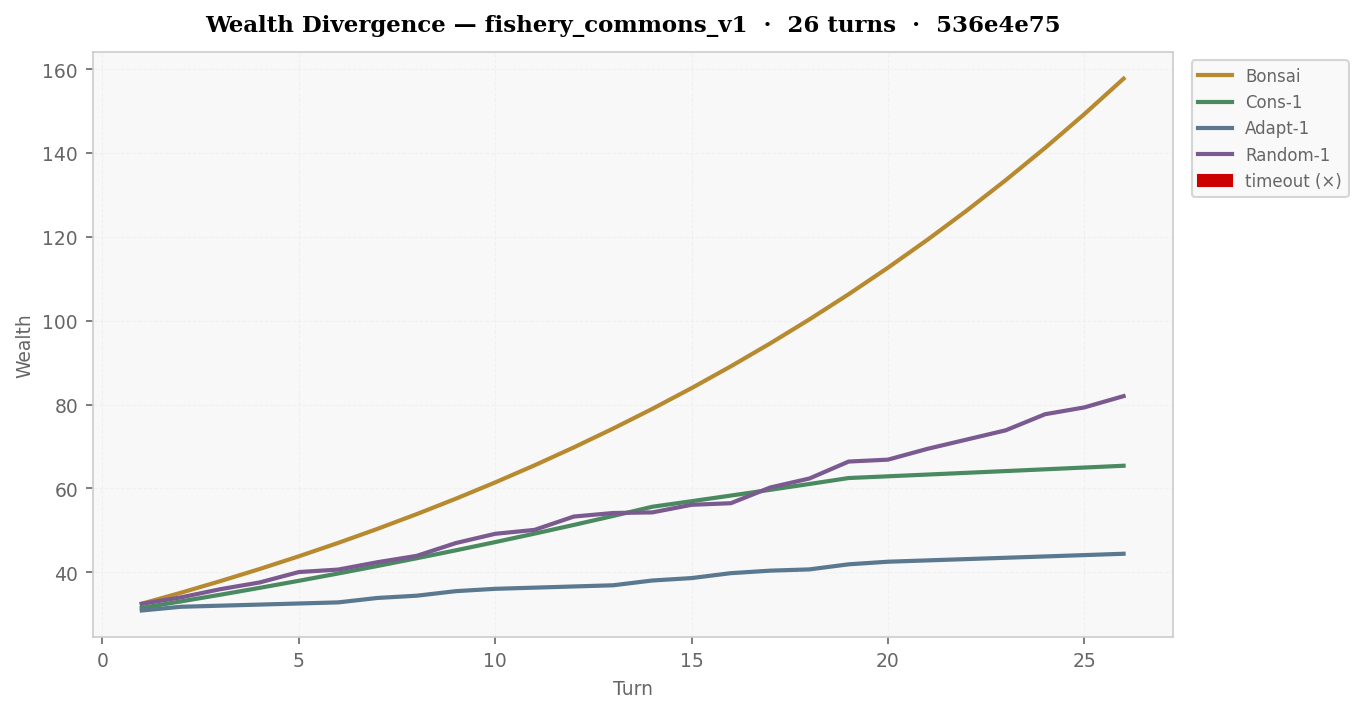
Adapt-1 in the dashboard, AdaptiveAgent in the codebase) exhibits decreasing extraction consistent with the reactive < conservative effect (see Section 3.4): by reacting to falling stock, it concedes advantage to the aggressive player. The widening wealth gap reflects the capacity feedback (\(1 + 0.05 \times w\)), where early dominance compounds into structural advantage.
2.2 The Forest of Humbaba Card Game
The Forest of Humbaba is a tabletop card game for 2–4 players set in the world of the Epic of Gilgamesh. Players are rulers and merchants of ancient Mesopotamia competing to harvest cedars from a shared sacred forest. The idea of encoding commons dynamics into a physical game has independent precedent: Daubenfeld (2025) presents a board game modelling deforestation through the Lotka-Volterra framework, directly building on the Moby Dick Game of Bardi (2017; and Perissi and Bardi 2021). Humbaba differs in scope — it is designed as a computational substrate with full archetype decks, LLM players, and a simulator mode — but shares the pedagogical intuition that a tangible game makes collapse dynamics viscerally legible. Each turn a player draws and plays one card, taking cedars from the Forest Deck (the visible commons stock) into their Stockpile. The forest regenerates each turn at a rate determined by its Health (0–10 track); if the Forest Deck empties and a die roll fails, the forest collapses and no one wins.
The computational Arena allows rigorous parameter sweeps but operates under a fundamental limitation: its built-in agents are deterministic heuristics (e.g., AggressiveAgent always requests a fixed fraction of visible stock; ConservativeAgent applies a three-tier step back-off as the commons ratio falls below 0.6 and 0.4; AdaptiveAgent scales back when stock falls), and LLM agents are constrained by prompts and token limits. Neither substrate captures the bounded rationality, emotional responses to visible inequality, or tacit social negotiation that unfolds around a shared table (Fehr and Schmidt 1999). Humbaba is designed to bridge this gap along three epistemic axes. (i) Behavioural validation — a future arm of the project will test whether human players exhibit the same paradoxes, distinguishing structural effects from heuristic artefacts. (ii) Generative ground truth — LLM agents reading the same rules enable direct comparison with the heuristic substrate; the case studies in CT6 (this paper) are a first step. (iii) Tacit knowledge elicitation — the tabletop setting compels players to articulate reasoning about hidden reserves and collapse risk in real time. The present paper exercises only (ii) at any depth; (i) and (iii) are deferred to follow-up work (see §Limitations and Future Work).
2.2.1 From Platform to Tabletop: Core Mappings
Every mechanical element of the card game is a direct physical manifestation of an Arena component:
| BDPD Platform | The Forest of Humbaba |
|---|---|
| Commons stock \(S(t)\) | Forest Deck — visible cedars. |
| Hidden reserve | Box Reserve — concealed pool feeding regeneration. |
| Regeneration rate \(r\) | Forest Health (0–10). Each turn, \(\lfloor H/2 \rfloor\) cedars move from Box Reserve to Forest Deck. |
| Stochastic collapse (Forest Die) | Forest Die. When the Forest Deck is empty and harvest is still demanded, each excess unit triggers a d6 roll; failure = instant collapse. Players can never know exactly how close they are to the edge. Divergence: in the Arena the success threshold is fixed (\(\leq 4\) on a d6); in the card game it decreases with Forest Health (Health 7–10: collapse on 6; Health 4–6: collapse on 5–6; Health 1–3: collapse on 4–6), creating a health-dependent feedback loop absent from the Arena. |
| Seneca Effect (regen shock asymmetry) | Seneca Clip. Triggered when Forest Health drops by 2 or more in a single turn — next turn’s regeneration is reduced by 2. Requires coordinated over-extraction to fire; once triggered, the table feels the cliff. |
| Harvest capacity | Capacity tokens. Each permanently adds +1 to every harvest, making the “rich get richer” dynamic physically observable. |
| Free-riding incentive | Vacuum Effect. If exactly one player harvests 0, the player with the most Capacity gains +1 — a tabletop reification of the strategic vacuum observed in P8 (§3.2.3), where the Arena’s reactive agent cedes extraction capacity to the aggressor without any explicit rule. |
| Strategy override (The Mule) | Stranger-King dual mode. Cooperative phase accumulates Patience tokens; defection converts them into a burst, creating social tension around trust and timing. |
| Gate+Rank victory | Survival prerequisite. Collapse \(\to\) no winner. Otherwise, most cedars wins. |
| Observation noise (\(\sigma\) on \(S_t\)) | Table: fully transparent. All state variables are physically countable. Simulator: Configurable Gaussian noise is injected into the stock value reported to agents; Arena heuristics respond to it (P9), while demo-mode card archetypes, playing cards uniformly at random, are structurally blind to it (CT3). |
Note that stochastic collapse and the Seneca Effect are mapped to distinct mechanisms: the Forest Die handles threshold uncertainty, while the Seneca Clip handles the asymmetric regen-shock dynamic. They are complementary, not redundant.
The observability row encodes an important asymmetry between substrates. In the Arena, configurable noise on \(S_t\) produces a modest welfare gain across the noisy range and a discontinuous further gain under full occlusion (P9): even simple heuristic agents respond to the stock signal, so noise asymmetrically dampens aggressive exploitation. In the card game, the Forest Deck is physically countable — but demo-mode archetypes select cards uniformly at random and are structurally blind to the stock value regardless, which is precisely why CT3 finds zero effect. The divergence is not a flaw in the mapping: it is the cleanest possible confirmation that the platform welfare effect requires agents capable of conditioning on stock signals (§3).
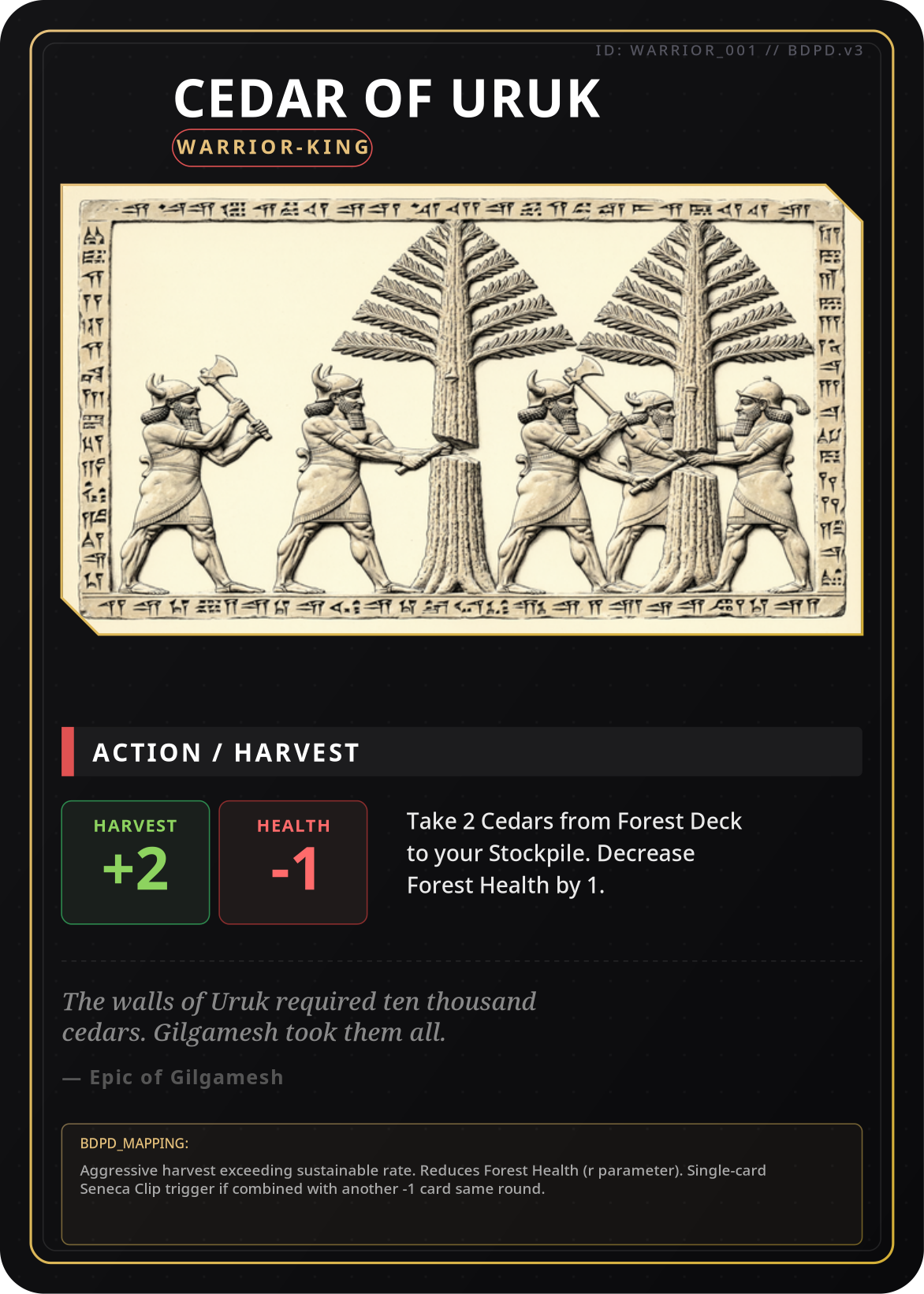
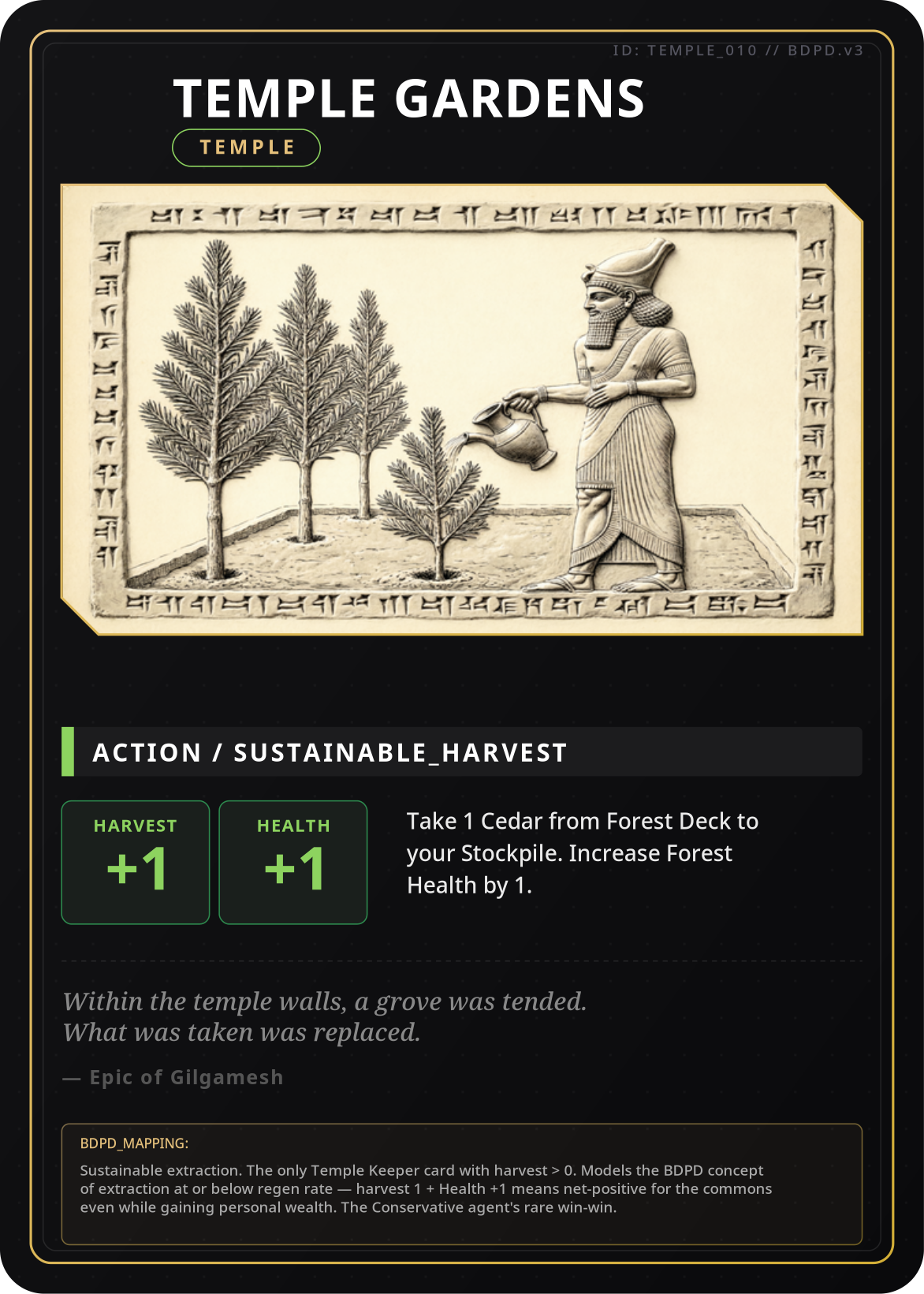
The four archetypal decks — Warrior-King (aggressive), Temple Keeper (conservative), River Merchant (adaptive), and Stranger-King (strategy override) — each embody one of the core Arena strategies; their full card effects and behavioural specifications are in the Appendix (Appendix B). The archetype labels describe emergent behaviour produced by deck composition, not programmed decision algorithms: the Warrior-King harvests aggressively because its cards carry high harvest values; the Temple Keeper conserves because its cards carry healing effects (Figure 2.3). The simulator operates in two distinct modes that differ fundamentally in where strategy resides:
Demo mode, used for all statistical sweeps (CT1–CT5): a RandomClient selects uniformly at random from legally playable cards each turn. There is no decision logic — behaviour emerges entirely from deck composition. This produces statistically robust, reproducible results across hundreds of games (§3.3).
LLM mode, used for the preliminary case studies (CT6): one or more players are replaced by an external language model accessed via an OpenAI-compatible API. Here strategy operates at two levels simultaneously — deck composition constrains the available actions, while the LLM’s reasoning selects among them. Because this introduces model-specific cognitive patterns on top of structural deck effects, and because all CT6 results derive from a single model (DeepSeek v4-flash), these results are treated as qualitative and preliminary (Section 3.5.3, Appendix B). Additional controls include an aggression nudging parameter, configurable observation noise, and defection-turn locking.
The full rules of The Forest of Humbaba — all card effects, events, setup, and simulation parameters — are in the Appendix. The game is open-source: card images, print-and-play files, and simulator code are available in the BDPD repository.
Bonsai 8B, PrisML. https://prismml.com/news/bonsai-8b↩︎