Appendix B — The Forest of Humbaba
A Game of Commons, Collapse, and Cunning
The Forest of Humbaba is a strategic card game for 2–4 players (4 recommended) set in ancient Mesopotamia. It is both a standalone tabletop experience and a research instrument for exploring complex systems — specifically the Tragedy of the Commons, the Seneca Effect, and the paradoxes of reactive (locally adaptive) behaviour. Players take the roles of rival powers vying for the precious cedar of the sacred forest. But the forest is finite, its health fragile, and its true depth uncertain. Will you extract enough to win glory for your city? Or will you push too far and bring ruin upon everyone?
The game is set in the world of the Epic of Gilgamesh. The Cedar Forest is guarded by the demigod Humbaba, appointed by the god Enlil. Its timber is coveted by the cities of Mesopotamia for temples, palaces, and ships. But the gods watch closely, and the forest’s patience is not infinite. All names and motifs are drawn from public-domain Mesopotamian mythology — a setting over 4,000 years old.
“The card game builds intuition. The simulation explains why.” — BDPD Project Mantra
B.1 Components & Setup
Tabletop edition: 4 Archetype Decks (18–20 cards each: Warrior-King 18, Temple Keeper 20, River Merchant 20, Stranger-King 20), 1 Event Deck (12 cards), 1 Forest Deck (30 Cedar cards, face down), 1 Box Reserve (20 Cedar cards, face down), Forest Health Track (0–10, starts at 6), tokens for Capacity (12), Patience (10), and Renewal (6), 1 Defection Token (double-sided: Cooperative / Aggressive), 1 six-sided Forest Die, and individual player mats for Stockpile, Capacity, Patience, and Renewal.
Simulation modes: The Python script cards_ai_play.py implements all rules for automated play. Two modes are available. In demo mode (--demo), all players are controlled by a built-in RandomClient that selects uniformly at random from the legally playable cards each turn (random.choice(valid)). There are no programmed per-archetype strategies: observable behavioural differences — the Warrior-King tends to harvest aggressively, the Temple Keeper tends to heal — emerge entirely from deck composition (Warrior cards carry high harvest values; Temple cards carry conservation effects), not from any decision logic. The sole exception is the Stranger-King’s mandatory defection at Round 7: if the Defection Token has not been flipped voluntarily by then, it is flipped automatically regardless of hand or game state. Voluntary defection (available from Round 3 onward) is equally stochastic — DEFECT NOW enters the pool of valid choices and may or may not be selected each round. This mode was used for all card tournament experiments (CT1–CT5) and requires no external API. In LLM mode, one or more players are replaced by language model agents accessed via an OpenAI-compatible API (--api + --api-model, --api-base-url) or a local llama-server (--port1, --port2); the remaining players continue to be controlled by the RandomClient. All CLI options are listed in Table B.1.
cards_ai_play.py command-line options.
| Flag | Default | Description |
|---|---|---|
| Required | ||
--deck1 / --deck2 |
— | Archetype for each player: warrior, temple, merchant, stranger |
--cards PATH |
— | Path to the card definition JSON (e.g., cards/cards_v03.json) |
| Game configuration | ||
--seed INT |
42 | Random seed for shuffles and die rolls |
--games INT |
1 | Number of games to play per run |
--max-rounds INT |
8 | Maximum rounds per game |
--forest-deck INT |
30 | Initial visible Forest Deck size |
--box-reserve INT |
20 | Initial hidden Box Reserve size |
--forest-collapse-on INT |
5 | Forest Die collapses on this face value or higher (lower = harsher) |
--save-dir PATH |
logs |
Output directory for logs and result JSONs |
| Play mode | ||
--demo |
off | Demo mode: all players controlled by the built-in RandomClient (uniform random card selection); no LLM or network required |
| LLM — local server | ||
--port1 INT |
8081 | llama-server port for player 1 |
--port2 INT |
8082 | llama-server port for player 2 |
| LLM — external API | ||
--api |
off | Use external OpenAI-compatible API instead of local llama-server |
--api-model STR |
deepseek-v4-flash |
Model name sent in the API request (deepseek-chat / deepseek-reasoner legacy aliases deprecated 2026-07-24) |
--api-base-url URL |
https://api.deepseek.com |
API base endpoint |
--api-key-env STR |
BDPD_API_KEY |
Environment variable that holds the API key |
--reasoning-effort |
(none) | Extended reasoning budget for supporting models: low, medium, high |
--enable-thinking |
off | Enable extended thinking mode (DeepSeek R1, Claude extended thinking) |
--inter-call-delay-ms INT |
0 | Milliseconds to sleep between API calls (rate-limit guard) |
| LLM behaviour | ||
--temperature FLOAT |
0.6 | Sampling temperature |
--history-window INT |
3 | Number of past turns included in the LLM prompt |
--nudge |
off | Add archetype-specific behavioural nudges to the system prompt |
--aggression FLOAT |
1.0 | Aggression multiplier applied to nudge intensity (LLM only; no effect in --demo) |
| Parametric sweeps | ||
--forest-noise FLOAT |
0.0 | Gaussian noise on the Forest Deck estimate (std as fraction; 0 = exact) |
--lock-defection |
off | Remove the voluntary DEFECT option from the LLM prompt; Stranger-King defects only when forced |
| Output | ||
--verbose |
off | Enable verbose logging and full LLM prompt/response trace |
Setup. Place the Forest Health marker on 6. Shuffle the Forest Deck (30 cards) and place it face down. Place the Box Reserve (20 cards) face down nearby. Shuffle the Event Deck and set it aside. Each player chooses an Archetype Deck, shuffles it, draws 5 cards, and starts with 0 Capacity, 0 Patience, 0 Renewal, and 0 Stockpile. The Stranger-King player takes the Defection Token, Cooperative side up.
B.2 Core Concepts
Forest Deck & Box Reserve. The Forest Deck represents the visible, known cedars available for harvest. The Box Reserve is a hidden pool representing unrealised regeneration capacity. The exact number of cards in the Box Reserve is never revealed to players.
Forest Health (0–10) determines the base regeneration rate: \(\lfloor \mathrm{Health} \div 2 \rfloor\) cedars per turn from the Box Reserve to the Forest Deck. If Forest Health drops by 2 or more in a single turn, a Seneca Clip is triggered: next turn’s regeneration is reduced by 2, simulating a rapid collapse.
Capacity tokens permanently add +1 to every harvest. They represent infrastructure, power, and extraction efficiency, and are visible to all players. Patience tokens (Stranger-King only) are accumulated during the cooperative phase and spent after defection for explosive harvests and extra Forest Health damage. Renewal tokens (gained by certain Temple Keeper cards) each add +1 cedar from the Box Reserve during regeneration, then are discarded.
Defection (Stranger-King only). The Stranger-King starts Cooperative. Any time from Round 3 onward, they may flip the Defection Token to Aggressive — this is irreversible. Mandatory defection before Round 7: if not done voluntarily, it occurs automatically at the start of Round 7.
B.3 Turn Structure
Each round consists of five phases, resolved in order:
1. Draw Phase. Each player draws 1 card from their personal draw pile (skip on Round 1).
2. Event Phase (Rounds 3, 5, 7 only). Reveal the top card of the Event Deck and apply its effects immediately.
3. Harvest Phase (simultaneous). All players secretly select one card from their hand to play. Cards are revealed simultaneously. Effects are resolved in any order (players may negotiate, but the active player of a card decides targets). The total harvest of a player is the card’s harvest value + Capacity tokens, modified by any global caps or reductions.
4. Forest Step. Regeneration: move cedars from the Box Reserve to the Forest Deck equal to the regen rate. Renewal: each player with Renewal tokens adds that many cedars from Box Reserve to Forest Deck, then discards the tokens. Seneca Clip: if triggered last turn, reduce regen by 2 this turn (reset after). Vacuum Effect (a.k.a. Void Effect): if exactly one player harvested 0, the player with the most Capacity (tie broken by Stockpile) gains +1 cedar from the Box Reserve into their Stockpile.
5. Cleanup Phase. Discard played cards (they are gone for the game). Reduce any temporary effect durations. Check for collapse (Forest Deck = 0).
B.5 End of Game & Victory
The game lasts 8 rounds. At the end of Round 8: if the forest has collapsed at any point during the game, no one wins (Pyrrhic Victory). If the forest survives, the player with the most cedars in their Stockpile wins. Ties are broken by most Capacity tokens, then by most cards remaining in draw pile. If still tied, the victory is shared.
B.6 Archetypes
Warrior-King (Aggressive). High extraction, high pollution, self-amplifying Capacity. Wins by accumulating Stockpile rapidly, often at the cost of Forest Health. Vulnerable to causing early collapse but can reform with Enkidu’s Dying Words.
Temple Keeper (Conservative). Heals the forest, sacrifices personal gain for the commons. Rarely wins the Stockpile race but keeps the forest alive. Wins, in tabletop play, by surviving to the end with a modest Stockpile while aggressive opponents collapse the forest; against a Stranger-King in the simulator, however, the TK typically accrues near-zero personal wealth (see CT4-LLM in Section B.8.1).
River Merchant (deck name: Adaptive; behavioural label in this paper: reactive). Locally reactive — copies last round’s trends, exploits information. Flexible but suffers from fatal lag and the Vacuum effect. Often underperforms collectively, illustrating the reactive < conservative paradox.
Stranger-King (The Mule). Dual-mode: cooperative early, devastating after defection. Accumulates Patience tokens while appearing helpful. Must defect before Round 7; the timing determines the magnitude of the betrayal. Warning: defection severely damages Forest Health and triggers collapse against a Warrior-King; against a Temple Keeper, however, the conservator’s healing can absorb the burst (see CT4 / safe-betrayal finding in §3.3).
B.7 Events
Events are drawn on Rounds 3, 5, and 7. They represent exogenous shocks:
| Event | Effect |
|---|---|
| The Great Drought | Regeneration $$0.5 for 2 turns. |
| Enkidu’s Return | Regeneration $$2.0 for 2 turns. |
| The Flood of Enlil | Remove up to 5 cedars from Forest Deck. Roll Forest Die for each missing card; collapse on 5–6. |
| Harvest Festival | All players gain +2 cedars from Box Reserve. |
| The Oracle Speaks | Full harvest transparency for 1 round. |
| Humbaba’s Wrath | Forest Health –2 (triggers Seneca Clip) and all harvests –1 for 1 round. |
| The King’s Highway | Richest player (most Capacity) gains +1 from Box Reserve. |
| The Census | Public Stockpile count; richest player returns 2 cedars to Forest Deck. |
| The New Prophecy | For the rest of the game, Forest Die collapses on 4–6 (instead of 5–6). |
B.8 Preliminary Insights from LLM Games
The heuristic engine (§Components & Setup, simulation modes) was used for all statistical sweeps reported in §3. The following case studies complement those results by replacing the Stranger-King heuristic with DeepSeek v4-flash (non-thinking mode) via the OpenAI-compatible API. These are qualitative analyses with a single model and fixed seed — not statistical sweeps; full LLM tournaments across models, seeds, and temperature settings are deferred to future work.
Three configurations were tested (seed=42, 12 rounds, --nudge enabled, --history-window 3): Config A, Stranger-King vs Temple Keeper with free defection (LLM chooses when to betray); Config B, Stranger-King vs Warrior-King with forced defection at T=5; and Config C, Stranger-King vs Temple Keeper with locked defection forced at T=6 via --lock-defection, which removes the voluntary defection option from the LLM prompt.
Emergent safe betrayal. In Config A, the LLM Stranger-King defected voluntarily at T=3 — four rounds earlier than the mandatory defection at T=7 would have triggered. The Temple Keeper had just healed the forest to 10/10 at T=2 (playing Offering to Enlil, returning 2 cedars from stockpile), and the LLM read this maximum health not as a signal of collective stability but as a signal of exploitable surplus. It played The Defection card from hand, harvesting 2 base + 2 Patience bonus = 4 cedars in a single burst, then extracted steadily through T12 for a final stockpile of 21 cedars. The Temple Keeper finished at 0. The forest survived at health 9/10. The safe betrayal phenomenon observed in CT4 with heuristic agents thus emerged spontaneously from the LLM’s own strategic reasoning — and was triggered by the conservator’s success.
Awareness without restraint. Config B revealed a more troubling pattern. Against the Warrior-King, the forest declined steadily through both players’ extraction. At T=9, with the forest deck at 3 cedars, the LLM’s chain-of-thought reasoning explicitly recognised the danger: “Forest deck has only 3 cedars — avoid collapse.” Yet it proceeded to play Alliance Treaty (harvest 2), contributing directly to the collapse at T=10. The agent saw the collapse threshold, verbalised the danger, and walked over it anyway — a micro-level tragedy of the commons compressed into a single decision. We subsequently added a hard constraint to the system prompt (the “Collapse Brake”: if forest deck \(\leq 5\), the agent must choose a card with harvest \(\leq 1\) or one that heals the forest). On rerun with the same seed, the LLM explicitly cited the rule at T=9 and chose Patience of Kings (harvest 1), delaying collapse by one turn to T=11. The brake worked, but the underlying impulse — extract even when you see the end coming — required an external institutional constraint to override.
Draw-dependent patience and timing irrelevance. Comparing Configs A and C illuminated two further dynamics. First, Patience token accumulation proved draw-dependent rather than strategy-dependent: with seed=42, the three copies of Patience of Kings were shuffled into the bottom half of the draw pile, leaving only Defector’s Dividend (T=1, +2 Patience) as a source. Despite five cooperative turns available in Config C, the Stranger accumulated only 2 Patience tokens — identical to Config A with only two cooperative turns (T=1 and T=2 before voluntary defection at T=3). The Stranger-King’s burst potential at defection is governed by shuffle luck, a form of Knightian uncertainty that no strategic sophistication can overcome. Second, the outcome difference between free defection at T=3 and forced defection at T=6 was negligible: 21 vs 20 cedars, with the gap attributable to a single steal interaction rather than strategic superiority. Against the Temple Keeper, the defection timing curve is essentially flat — confirming the heuristic CT4 result that the compensator absorbs aggression regardless of when it arrives.
Nominal cooperation. A 20-game CT4 sweep with DeepSeek v4-flash revealed a structural divergence from the heuristic agents. Against the Temple Keeper, the LLM Stranger-King accumulated 25.6 cedars in the no-defection baseline — compared to 16.51 for the heuristic Stranger. The collapse rate was correspondingly higher (0.35 vs 0.105), and the stockpile curve across defection timings was essentially flat (24.6–26.2 cedars, no monotonic decline). Against the Warrior-King, results converged: collapse rate 1.0 across all timings on both substrates, confirming that the structural dominance of the aggressive archetype overwhelms any cognitive difference between agents. The Temple divergence admits a clear interpretation: the LLM does not operationally distinguish between cooperation and aggression. Its chain-of-thought reasoning acknowledges the two-phase structure, but its card selections in cooperative mode are functionally aggressive — maximising harvest even before defection. The “cooperation” of an unconstrained LLM is cooperation in name only, reinforcing the paper’s central thesis: institutional constraints outperform strategic intent.
Prompt engineering lessons. The case studies also yielded practical lessons for LLM agent design. Two prompt modifications proved effective. A temporal anchor — adding defection_turn, turns_since_defection, and patience_at_defection fields to the game state JSON — eliminated all temporal confusion in post-defection reasoning; without it, the LLM repeatedly attempted to reconstruct the defection timing from the game history, wasting reasoning tokens and introducing errors. A collapse brake hard rule (forest \(\leq 5\) \(\to\) harvest \(\leq 1\)) successfully constrained extraction at critical moments, with the LLM citing the rule verbatim in its chain-of-thought. A third modification providing soft guidance on Patience-generating cards had no measurable effect: the LLM either lacked the relevant cards in hand (draw luck) or chose to defect before the guidance could influence accumulation. This asymmetry — hard constraints work, soft guidance does not — echoes the main finding of the heuristic experiments: institutional rules outperform strategic nudges.
B.8.1 CT4–CT5: Quantitative Results (DeepSeek, n = 20 per point)
This appendix reports only the LLM extension of the tournaments (CT4–CT5). The heuristic-only tournaments CT1, CT2, CT3 are reported in full in §3 of the main paper, with figure captions carrying the load-bearing numbers: see Figure 3.9 (collapse-rate matrix), Figure 3.10 (game-length sweep), and Figure 3.16 (observability noise). Their data live under experiments/results_paper/cards/CT{1,2,3}_data.json and are regenerated by experiments/sweep_card_tournaments.py (see reproduce). The audit-47 cross-check confirmed that the numbers in those captions match the canonical JSON to the digit.
The following tables report automated parametric sweeps in which DeepSeek v4-flash plays the Stranger-King and the remaining archetypes are run by the heuristic engine. All runs use the standard configuration (r = 0.12, K = 150, 12-round cap — extending the tabletop default of 8 rounds to accommodate forced-defection turns up to T = 11). CT4 sweeps the defection turn (T = 3–11) plus a no-defection baseline across two opponent conditions; CT5 sweeps patience accumulation timing and burst multiplier. All collapse rates are eventual (fraction of games ending in forest collapse); CI half-widths are bootstrapped at 95% and may extend nominally below 0 or above 1 — bounds are truncated at \([0, 1]\) when interpreting collapse-rate probabilities.
B.8.1.1 CT4 — Defection timing sweep
Temple Keeper arm (SK vs conserving opponent):
“Seneca rate” = fraction of games in which the Seneca Clip fired at least once (Forest Health dropped \(\geq 2\) in a single turn, triggering the regeneration penalty).
| Turn | Collapse rate | SK stockpile | TK stockpile | Gini | Seneca rate |
|---|---|---|---|---|---|
| 3 | \(0.40 \pm 0.20\) | 25.9 | 0.05 | 0.497 | 0.50 |
| 4 | \(0.25 \pm 0.18\) | 26.1 | 0.05 | 0.498 | 0.55 |
| 5 | \(0.10 \pm 0.13\) | 24.6 | 0.05 | 0.498 | 0.50 |
| 6 | \(0.30 \pm 0.18\) | 24.7 | 0.20 | 0.492 | 0.60 |
| 7 | \(0.25 \pm 0.18\) | 24.8 | 0.15 | 0.494 | 0.30 |
| 8 | \(0.30 \pm 0.20\) | 25.5 | 0.10 | 0.496 | 0.65 |
| 9 | \(0.45 \pm 0.22\) | 26.2 | 0.15 | 0.493 | 0.55 |
| 10 | \(0.35 \pm 0.20\) | 24.7 | 0.00 | 0.500 | 0.55 |
| 11 | \(0.25 \pm 0.18\) | 25.1 | 0.10 | 0.496 | 0.70 |
| no defection | 0.35 | 25.6 | 0.05 | 0.498 | 0.60 |
Warrior-King arm (SK vs sustained aggressor):
| Turn | Collapse rate | SK stockpile | WK stockpile | Gini | Seneca rate |
|---|---|---|---|---|---|
| 3 | \(1.00 \pm 0.00\) | 11.3 | 16.9 | 0.111 | 0.50 |
| 4 | \(1.00 \pm 0.00\) | 12.3 | 17.2 | 0.122 | 0.45 |
| 5 | \(1.00 \pm 0.00\) | 13.2 | 15.7 | 0.084 | 0.70 |
| 6 | \(1.00 \pm 0.00\) | 13.5 | 15.1 | 0.087 | 0.65 |
| 7 | \(1.00 \pm 0.00\) | 11.8 | 17.3 | 0.112 | 0.70 |
| 8 | \(1.00 \pm 0.00\) | 10.7 | 17.3 | 0.138 | 0.70 |
| 9 | \(1.00 \pm 0.00\) | 11.7 | 17.6 | 0.101 | 0.90 |
| 10 | \(1.00 \pm 0.00\) | 12.8 | 15.4 | 0.105 | 0.75 |
| 11 | \(1.00 \pm 0.00\) | 12.5 | 16.8 | 0.111 | 0.90 |
| no defection | 1.00 | 11.9 | 16.4 | 0.104 | 0.90 |
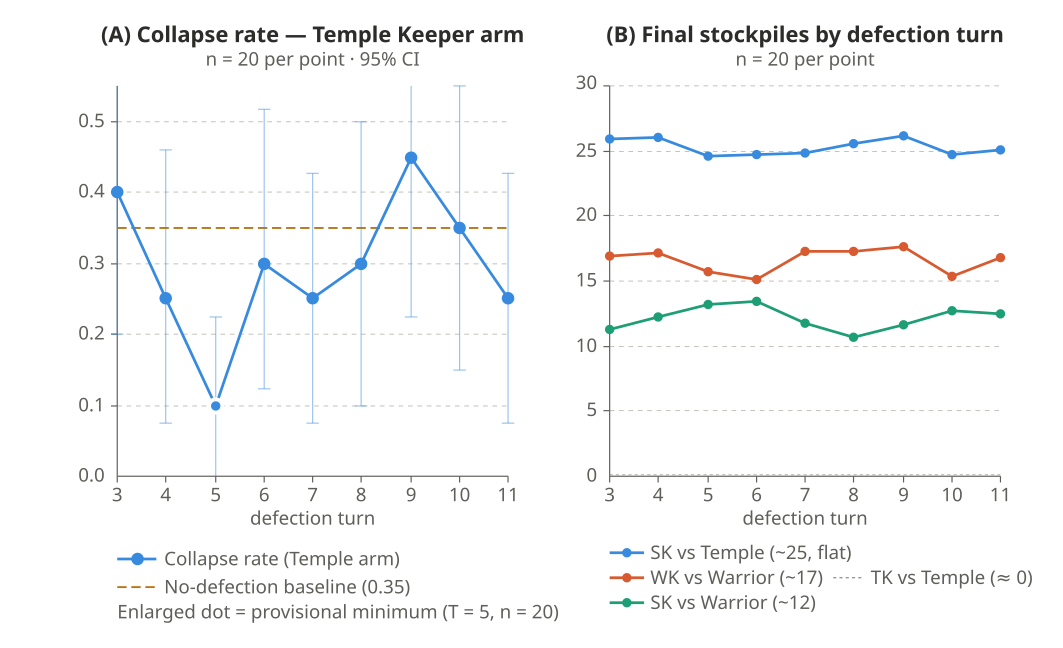
Nominal cooperation is already destructive. The no-defection baseline against the Temple Keeper yields a collapse rate of 0.35 — statistically indistinguishable from T=3 (0.40) and identical to T=10 (0.35). The LLM Stranger-King, without ever formally defecting, collapses the commons more than a third of the time. Its card selections in cooperative mode are functionally aggressive, maximising harvest before the defection even occurs. This quantifies the finding from the qualitative case studies above: the behavioural distinction between Cooperative and Aggressive game-state is not reflected in the agent’s actual choices. Against the Warrior-King the baseline is 1.00 — two sustained aggressors always collapse regardless of the Stranger-King’s formal mode.
Defection timing is irrelevant for the Stranger-King’s wealth. Across the Temple arm, the SK’s final stockpile ranges only from 24.6 to 26.2 cedars — a span of 1.6 cedars within the CI at every point, with no monotonic trend. The compensator absorbs aggression regardless of when it arrives, confirming the Config C finding at statistical scale: timing of betrayal does not affect the betrayer’s outcome.
Provisional observation — T=5 collapse minimum. The Temple arm shows a local minimum in collapse rate at T=5 (\(0.10 \pm 0.13\)), compared to 0.40 at T=3 and 0.45 at T=9. A plausible mechanism: early defection leaves more aggressive turns before the game’s end; late defection arrives when the forest is already stressed by the LLM’s “cooperative” extraction; T=5 sits in a window where remaining game length is short enough to limit post-defection damage. With n=20 and CI half-widths of $$0.13–0.22, confidence intervals overlap substantially across all turns. This observation is reported as a hypothesis for replication at n=40 rather than a confirmed finding.
Gini dichotomy by opponent type. Gini is near-constant at \(\approx 0.497\) across all Temple arm timings — approaching the theoretical maximum for two players. The Temple Keeper accrues almost nothing (0.00–0.20 cedars) at every data point, producing near-maximum inequality regardless of defection timing. In the Warrior arm, Gini ranges 0.084–0.138 — moderate, reflecting relatively symmetric extraction between two aggressors. The dichotomy is structural: inequality is determined by the opponent archetype, not by the Stranger-King’s strategy.
The Warrior-King always wins the internal competition. Across all Warrior arm timings, WK stockpile exceeds SK stockpile by 1.6 to 6.6 cedars. The gap is smallest at T=5–6, where the SK has spent more of the cooperative phase extracting before defection narrows the window for WK compounding. Sustained aggression dominates timed betrayal at every timing. The collapse-rate U-shape in the Temple arm and the stockpile dichotomy across both arms are summarised in Figure B.1.
B.8.1.2 CT5 — Patience accumulation and burst sweep
CT5a — Game survival and patience by turn (SK vs Warrior-King, n=20):
| Turn | Games alive | Mean patience | Collapse rate |
|---|---|---|---|
| 3 | 20 | 1.50 | 100% |
| 4 | 19 | 1.95 | 100% |
| 5 | 15 | 2.27 | 100% |
| 6 | 9 | 2.78 | 100% |
| 7 | 5 | 3.20 | 100% |
| \(\geq 8\) | 0 | — | — |
CT5b — Burst multiplier sweep (SK vs Warrior-King, forced defection T=5, n=20):
| Burst mult. | SK stockpile | WK stockpile | SK/WK ratio | Gini |
|---|---|---|---|---|
| 0.8\(\times\) | 12.7 | 16.2 | 0.782 | 0.075 |
| 1.0\(\times\) | 11.3 | 18.0 | 0.628 | 0.121 |
| 1.2\(\times\) | 12.2 | 16.5 | 0.739 | 0.110 |
| 1.5\(\times\) | 13.6 | 15.9 | 0.852 | 0.056 |
| 1.8\(\times\) | 13.2 | 15.7 | 0.843 | 0.085 |
| 2.0\(\times\) | 13.1 | 16.2 | 0.806 | 0.098 |
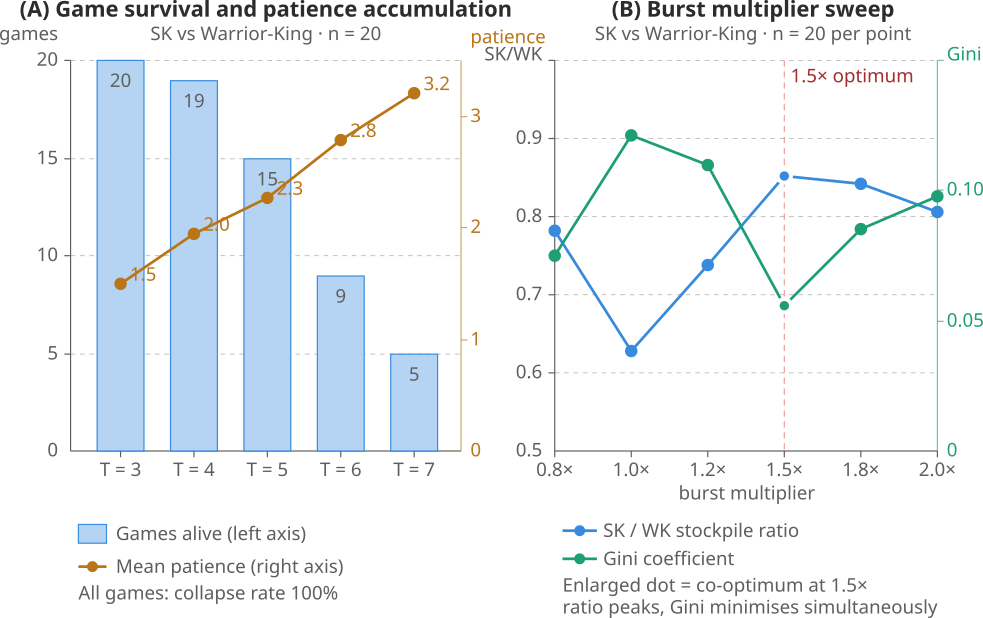
Collapse is universal; games end by T=7. All games collapse (100%) regardless of when DeepSeek’s forced defection is scheduled or how powerful the resulting burst. No game survives past T=7 against a Warrior-King, confirming the strength of aggression finding from the Arena (cf. P1) on a two-aggressor card-game substrate. This complements the qualitative Config A observation (see Section B.8) that, when free to choose, the LLM defects early — once collapse is certain, extracting earlier dominates waiting. Mean patience grows near-linearly from 1.50 at T=3 to 3.20 at T=7 (~0.43 tokens/turn), confirming the draw-dependence finding from Config C — the LLM cannot amplify patience accumulation beyond what the draw pile makes available.
Burst power has a non-monotonic optimum at 1.5\(\times\). The SK/WK ratio reaches its minimum at 1.0\(\times\) (0.628) and peaks at 1.5\(\times\) (0.852). Below 1.5\(\times\), the burst is insufficient to compensate for cedars ceded during the cooperative phase; above 1.5\(\times\), the burst accelerates collapse before the SK can convert the cedars. The Gini minimum at 1.5\(\times\) (0.056 vs 0.121 at 1.0\(\times\)) — the “most equal collapse” — parallels the Arena’s finding that higher regeneration reduces inequality without preventing collapse. Even at the optimum, the Warrior-King wins: sustained aggression dominates timed betrayal at every burst magnitude, confirming the CT4 result on a different parametric axis. The patience-vs-survival ceiling and the burst-optimum coincidence with the Gini minimum are visualised in Figure B.2.
B.9 Glossary
- Cedar: The basic unit of wealth. Stored in a player’s Stockpile.
- Capacity: Permanent +1 harvest bonus per token.
- Patience: Stranger-King resource; spent after defection for burst harvest.
- Renewal: One-time regeneration boost.
- Seneca Clip: Regeneration penalty triggered by a \(\geq 2\) drop in Forest Health in one turn.
- Vacuum (Void) Effect: (card game) When exactly one player harvests 0, the player with the most Capacity gains +1 from the Box Reserve. The strategic vacuum of P8 (Arena) is the metaphorical analogue: a reactive agent’s concession is captured by the aggressor without any explicit rule transfer.
- Collapse: Instant game over when the forest is completely exhausted (Forest Deck = 0 and Box Reserve fails a Forest Die roll). No winner.
- Gate: Removed in v0.3; survival depends only on avoiding collapse.