4 Discussion and Future Work
4.1 Interpretation and Implications
The experiments reported in §3 converge on a set of findings that are collectively coherent and somewhat surprising. The discontinuous step-collapse threshold, the reactive < conservative effect, the welfare-optimal noise level, and the structural fragility to late defection are not isolated results — they form a consistent picture of how strategic heterogeneity, information asymmetry, and institutional design interact in a commons under pressure. This section interprets these findings against the theoretical framework, highlights the divergences between the two experimental substrates, and draws out the implications for governance design. We begin with the cross-cutting insights that emerge from the dual-mode comparison, then examine two phenomena that warrant dedicated discussion — the Tragedy of the Compensator and the mapping to Ostrom’s design principles — before turning to policy implications, limitations, and future directions.
4.1.1 Dual-Mode Insights: When the Card Game Diverges from the Arena
The BDPD framework’s dual-mode design — spanning a continuous logistic Arena and a discrete, stochastic card game — reveals that the substrate of interaction fundamentally modulates how theoretical dynamics manifest. Three key divergences stand out:
Probabilistic vs. Binary Thresholds (RQ1). In the Arena, a single aggressive agent creates a deterministic tragedy: the gate pass rate drops to exactly 0% (P1–P3, within the canonical regime). In the card game, the stochastic Forest Die transforms this certainty into a probability. Even in the most aggressive matchup (Warrior vs. Warrior), the collapse rate is 81.5%, leaving an 18.5% residual survival window. Real-world common-pool resources with hidden, stochastic reserves may exhibit more resilience than continuous models predict — though the probability of collapse remains unacceptably high.
Noise as a Selective Blunter (RQ3). The Arena sweep P9 reveals a non-obvious result: observation noise improves collective welfare even with simple heuristic agents, in two distinct regimes — a modest gain across the noisy range (welfare 63.0 → 66.4 from no noise to 50% noise) and a discontinuous further gain under full occlusion (welfare jumps to 70.9, Gini drops from 0.256 to 0.154). The mechanism is the same asymmetric blunting at different scales: noise degrades the aggressive agent’s fine-grained stock estimates and dampens extraction, while conservative agents — whose strategy does not depend on precise observation — are unaffected. Full occlusion is the qualitative limit case: with no signal at all, the aggressive agent loses its stock-sensitive advantage entirely, every agent defaults to capacity-bound extraction, and the wealth distribution becomes the most equitable of the sweep, at the cost of a faster collapse (22 turns vs. 28–29 under noise). The card game sweep CT3 produces a structural null by construction: demo-mode archetypes select cards uniformly at random and cannot respond to stock information regardless of its fidelity, so noise has exactly zero effect — as anticipated by the platform-to-tabletop mapping (Section 2.2). The combined result is not that noise is irrelevant, but that its welfare effect is entirely mediated by whether agents can act on stock signals (Simon 1955; Gigerenzer and Gaissmaier 2011). The substrate divergence is therefore part of the finding, not a methodological inconvenience.
Safe Betrayal and the Profitability of Defection (RQ4). The Arena’s Mule experiment (P11) demonstrated structural fragility: any defection destroys the cooperative equilibrium. The card game (CT4) reveals a further pathology: safe betrayal. Against a conservator (Temple Keeper), the Stranger-King can defect at any turn and extract significant personal wealth (up to 20.90 cedars at T=3, declining on average to 18.18 at T=11, vs. a no-defection baseline of 16.51) without triggering collapse. Forced defection slightly reduces the collapse rate below the no-defection baseline (0.05–0.10 vs. 0.105) — a bounded burst of aggression is less damaging than chronic strategic ambiguity.
The CT5 deep dive on the Stranger-King mechanics reveals three complementary findings. CT5a shows that Patience tokens accumulate roughly linearly with defection turn — yet against the Warrior-King, this accumulated potential is entirely irrelevant (collapse rate \(\geq 0.975\) regardless). CT5b confirms that the --aggression parameter has no effect in demo mode — as expected, since it is an LLM-only nudge and CT5 runs the heuristic engine; the experiment serves as a sanity check on parameter isolation, not as an empirical claim about assertiveness. CT5c shows that the Stranger-King reliably holds a full 5-card hand with stable aggressive potential (~11 cedars) at every defection turn — the weapon is always loaded, but its efficacy is gated by the opponent’s behaviour. Together, these confirm that structural position dominates strategic intent.
The preliminary LLM case studies (CT6) provide qualitative confirmation on a different cognitive substrate — situated within the Homo silicus framework (Horton et al. 2026) that treats language models as implicit computational models of human behaviour, and within the broader LLM-driven social-simulation taxonomy of Mou et al. (2026) — with the important caveat that all observations derive from a single model (DeepSeek v4-flash). When allowed to choose its own defection timing, the LLM Stranger-King consistently defected early — triggered by observing the forest at maximum health, a direct manifestation of the Tragedy of the Compensator. Against the Warrior-King, the LLM verbalised awareness of imminent collapse yet proceeded to extract aggressively in this single-model case study, exhibiting what we term — for diagnostic shorthand only, on the basis of a single-model case study — the awareness-without-restraint pattern: even agents with explicit situational understanding may lack the decision architecture to translate awareness into self-restraint without external enforcement. A complementary quantitative observation from the same case study: the LLM’s “cooperative” phase is functionally indistinguishable from its aggressive phase, producing nearly identical extraction regardless of defection status. An agent that understands cooperation but cannot practise it without external enforcement is, from the commons’ perspective, equivalent to a defector — reinforcing the paper’s central claim that institutional design must constrain worst-case behaviour, not optimise average intent. Systematic multi-model replication is required to establish the generality of these observations.
4.1.2 The Tragedy of the Compensator
We propose the term Tragedy of the Compensator for the dynamic in which a defector exploits a conservator’s ongoing restorative effort without triggering collapse — turning unilateral conservation into a subsidy for the defector. It is the discrete-time, dyadic cousin of Hardin’s tragedy: where Hardin’s many herders deplete a shared pasture, the Compensator’s one aggressor and one healer reach a stable disequilibrium in which the healer’s labour disappears into the aggressor’s stockpile.
The “safe betrayal” dynamic observed in CT4 — where a defector exploits a conservator’s healing without triggering collapse — operationalises this concept and bridges the computational findings with a painful reality of global environmental politics. In the Arena (P11), defection is universally catastrophic. In the stochastic card game, the Temple Keeper’s regeneration acts as an implicit subsidy to the Stranger-King’s aggression: by maintaining the forest above the collapse threshold, the conservator unintentionally creates the ecological slack the defector requires to extract safely. The substrate divergence — Arena collapses, card game absorbs — is itself diagnostic: it localises the safety condition. It is not the defection that kills the commons, it is the absence of an active healer powerful enough to outpace the burst.
The CT4 data quantifies this transfer precisely: the Stranger-King’s stockpile at T=3 (20.90 cedars) exceeds its no-defection baseline (16.51) by 27%, while the Temple Keeper’s stockpile remains near zero — the surplus created by conservation is captured entirely by the defector. In real-world climate negotiations, this maps onto the dilemma of “early movers” (Vasconcelos et al. 2014; Milinski et al. 2008): when a coalition implements strict emissions caps, the ecological buffer they create may allow others to continue cheap fossil-fuel extraction without triggering immediate systemic collapse. The cooperators subsidise the defectors’ profits; the system survives, but wealth distribution becomes increasingly skewed.
This finding should be interpreted within the boundary conditions of the model: it holds in a two-player setting without sanctioning mechanisms, exclusion rules, or reputational effects. With Ostrom-style graduated sanctions (Ostrom 1990; Yoon and Armsworth 2025) — which presuppose enforcement rather than communication alone (Ostrom et al. 1992) — or with the peer-punishment mechanism by which subjects voluntarily impose costly sanctions on free riders (Fehr and Gächter 2000), the dynamics may differ. The provision of such a sanctioning system is itself a second-order public good (Yamagishi 1986) and not free; the BDPD platform deliberately holds it out of scope here, isolating the structural dynamics, and leaves these mechanisms to the BDPD\(^1\) companion paper. Polycentric coordination (Vasconcelos et al. 2015) is the further extension taken up in BDPD\(^2\). Within these constraints, however, the implication is stark: unilateral conservation, without exclusion, transforms the commons from a shared resource into a subsidised extraction ground. In the absence of exclusion, resource exhaustion itself becomes the only stopping condition — the dark mirror of Hardin’s classical tragedy, in which the commons must collapse in order to free its cooperators.
4.1.3 Mapping to Ostrom’s Design Principles
The results map onto Ostrom’s eight design principles for sustainable CPR governance (1990). The mapping below is diagnostic rather than definitive: rows marked with an asterisk reflect indirect proxies or boundary conditions not directly varied in the experiments.
| Ostrom Principle | BDPD Finding |
|---|---|
| Clearly defined boundaries | Not directly implemented: BDPD imposes no access restrictions — any agent may harvest each turn regardless of behaviour. P6–P7 characterise the cost of this absence: neither asymmetric initial endowments (P6) nor wealth-weighted turn order (P7) alter the gate pass rate when an aggressive agent is unconstrained. The finding is diagnostic — exclusion mechanisms are precisely what the architecture lacks — rather than a demonstration that boundaries work. |
| Rules fit local conditions | P2–P3: regen rate and pool size do not alter the step-collapse threshold; rules must target agent type, not parameters |
| Collective choice arrangements | P7: scheduler (turn order) has negligible effect — confirmed by permutation test (welfare p = 1.000, B5); collective rules cannot compensate for individual defection |
| Monitoring | P9: observation noise on the commons stock improves welfare modestly across the noisy range and with a discontinuous further gain under full occlusion; CT3 provides a structural null — noise is irrelevant when agents cannot condition on stock signals |
| Graduated sanctions | P11, CT4: absent sanctions, even a late or bounded defection is irreversible; the Mule and safe betrayal both confirm this |
| Conflict resolution | Not directly implemented: BDPD has no negotiation, arbitration, or reciprocity protocol. P8 (Arena) and the Vacuum Effect (card game) both make the cost of this absence visible — a reactive concession is silently captured by the aggressor rather than read as a cooperative signal — but neither operationalises an actual dispute-resolution mechanism. The mapping is diagnostic of an architectural gap, not a positive design feature. |
| Recognition of rights | Not directly tested; a meta-agent governance extension would address this |
| Nested enterprises | Polycentric scale is configurable but not swept; future work |
4.1.4 Policy Implications
The results suggest three actionable implications. First, governance must target worst-case actors, not average behaviour: the discontinuous step means that optimising for the median agent is insufficient — a single unconstrained defector undoes cooperative gains (Santos and Pacheco 2011). Supplement B1 (Appendix B) localises this threshold precisely: even a minimally extractive aggressor (intensity \(i \approx 0.05\), 95% bootstrap CI [0.04, 0.05]) suffices to doom the commons within the canonical regime, placing the cliff well below any plausible regulatory exemption threshold.
Second, reactive policies are counterproductive: the reactive < conservative effect shows that institutions that pull back in response to resource signals create exploitable vacuums; unconditional rules outperform reactive ones. Supplement B2 quantifies this cost: each unit increase in reactive reductionFactor reduces collective welfare by 14.6 to 20.6 points across the tested regen rates, with all bootstrap CIs excluding zero. The strength of the externality scales with environmental generosity — making reactive policies most dangerous precisely when the commons appears healthiest.
Third, early movers need exclusion mechanisms: safe betrayal implies that unilateral conservation without the ability to sanction or exclude defectors is structurally self-defeating. Coalition agreements that lack enforcement provisions may inadvertently subsidise the actors they seek to pressure. The regime within which environmental abundance alone can absorb a canonical aggressor requires \(r \geq 0.95\) (95% CI [0.95, 1.025], Supplement B3) — nearly 3\(\times\) above the canonical parameter range (\(0.95/0.32 \approx 3\)) — confirming that environmental generosity is not a substitute for institutional exclusion.
4.2 Limitations and Future Work
Several limitations of the current study should be acknowledged. The seventeen experiments reported here represent strategic cross-sections of a much larger combinatorial space: with five agent strategies, three schedulers, eight perturbation types, and two engine modes, the base parameter space contains hundreds of combinations before considering continuous dimensions. Exhaustive coverage was neither intended nor feasible; under-sampled regions (mixed populations, graduated aggression intensities) are priorities for future work.
A methodological note. The symmetric logistic engine is not a limitation in disguise but a deliberate choice: it offers the most conservative possible substrate for the four findings reported here. Any asymmetric or threshold behaviour that emerges from a symmetric baseline (as in P10’s inverted shock response, or P1’s discontinuous collapse under proportional harvest) is therefore mechanism-driven rather than an artefact of the resource dynamics. The Seneca engine (Appendix A.1) provides the natural follow-up substrate where the opposite question can be asked: do these findings survive a model that is already asymmetric?
Further limitations concern the experimental design. First, the card tournaments are restricted to two-player matchups: the game rules support 2–4 players, but pairs were used for combinatorial tractability and to isolate pairwise strategy interactions before scaling to larger groups. The 3- and 4-player dynamics that arise with coalition formation, social pressure, and free-rider detection remain unexplored. Second, while the card game engine is stochastic, demo-mode agents select cards uniformly at random — they do not bluff, negotiate, or adapt strategically within a game. The LLM agents introduce stochasticity through temperature and can attend to the last three turns of game history via the prompt, but each card selection is an independent API call — there is no explicit multi-step lookahead or theory of mind. Third, the absence of inter-agent communication (“cheap talk”) means that the cooperative equilibria studied here rely on implicit coordination, not on the negotiation and sanctioning mechanisms that Ostrom identifies as critical (Ostrom 1990). Fourth, the CT4/CT5 experiments explore defection timing with a fixed defection profile; graduated or partial defection strategies remain untested. Fifth, the LLM experiments (CT6) are qualitative case studies with a single model; statistical generalisability across models, seeds, and temperature settings remains to be established.
4.2.1 What’s Next: Seneca and Beyond
The present paper validates BDPD on its logistic baseline — a symmetric engine chosen for tractability and cross-substrate comparability. The next step is to engage the phenomena that originally motivated the platform’s design.
Seneca dynamics. The Bardi three-variable (R, C, P) model (Bardi 2017) is already integrated into the Arena as a pluggable engine mode (v0.5.1; see Section A.1), with a dedicated rcp agent strategy that tracks capital and pollution signals to anticipate the cliff (Figure 4.1).
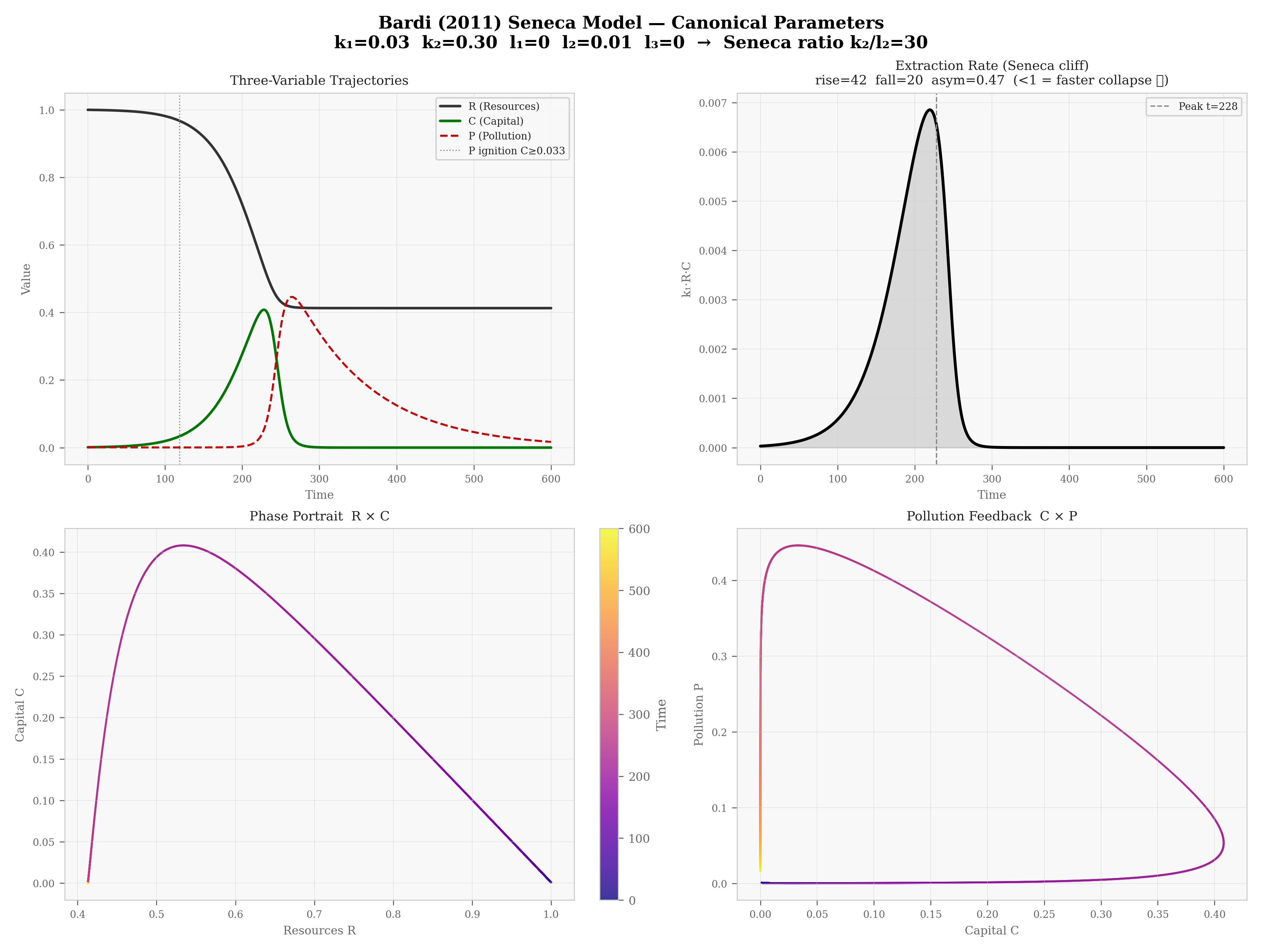
The core questions taken up in BDPD\(^3\) (Brunelli 2026c) are: Does the discontinuous collapse threshold (P1) sharpen or soften under true capital-pollution feedback? Does the reactive < conservative finding survive in a regime where the cliff is structurally asymmetric rather than shock-induced? Does safe betrayal persist when regeneration is governed by a pollution lag rather than a fixed rate? The engine is ready; the sweeps are next.
Governance mechanisms. All experiments reported here deliberately omit communication, sanctions, and exclusion — the baseline against which Ostrom-style interventions can be tested. A configurable meta-agent policy-maker that dynamically adjusts harvest caps, taxes, and monitoring noise would transform BDPD from a descriptive laboratory into a prescriptive design tool. The companion paper BDPD\(^1\) (Brunelli 2026a) closes this gap on the single-arena substrate (pacts, cheap talk, graduated sanctioning); BDPD\(^2\) (Brunelli 2026b) then lifts the governance question to nested polycentric worlds.
LLM generalisation. More sophisticated architectures — explicit memory, inter-agent messaging, and multi-turn planning — could test whether LLMs exhibit the “naïvety \(\to\) tragedy \(\to\) maturity” phase transitions observed by Pérolat et al. (2017). Systematic multi-model validation across architectures, temperatures, and turn horizons remains open.
True cross-substrate validation. The current demo-mode card tournaments use a RandomClient that selects cards uniformly at random — structurally blind to stock signals by design. This means the Arena (heuristic agents responding to observables) and the card game (random selection) do not yet share a common decision rule across substrates. Replacing the RandomClient with a minimal heuristic card bot — for example, “play the highest-harvest card when commons ratio exceeds 0.5, the lowest otherwise” — would allow the same decision logic to run on both substrates and enable genuine robustness testing across the dual-mode laboratory.
Human experiments. Empirical validation through human subject experiments will be crucial to assess whether safe betrayal and the tragedy of the compensator produce the same exploitative equilibria at the table as in simulation.
4.3 Methodological Coda: LLMs as Synthetic Collaborators
Two distinct roles of LLMs in this work should not be conflated. Role A (epistemic/generative): LLMs participated in conceptual development, implementation, and manuscript preparation — this is the methodological contribution acknowledged here. Role B (experimental): a single LLM agent (DeepSeek v4-flash) played The Forest of Humbaba as a generative subject in CT6 — this is an experimental observation, reported separately and treated as preliminary.
Focusing on Role A, this paper was developed through intensive, multi-month interaction with multiple frontier LLMs. Unlike standard prompt-and-revise usage, the workflow involved: (a) feeding models the full evolving manuscript to identify internal contradictions; (b) requesting alternative framings of each result to test narrative robustness; and (c) using models with different training distributions (Anthropic’s Claude, DeepSeek, Alibaba’s Qwen, Z.ai’s GLM-5.1) as a primitive form of epistemic cross-validation. When all models converged on the same interpretation of a result, confidence increased; when they diverged, the discrepancy surfaced an ambiguity worth resolving analytically — functioning as an asynchronous equivalent of a multi-disciplinary research group’s internal critique.
The successful coordination of multiple frontier LLMs across the full spectrum of a scientific project — from concept through code to manuscript — is therefore both the means and part of the message of this work. This procedure does not substitute for peer review. Rather, it suggests a scalable model for distributed sense-making in complex, interdisciplinary projects where a single researcher must simultaneously cover game theory, ecological dynamics, agent-based modelling, and policy implications. We report it not as a best practice but as a proof of concept: frontier LLMs, when orchestrated with domain expertise and methodological rigour, can act as substantive cognitive collaborators in original scientific research — standing as a methodological thesis alongside the empirical one (Boiko et al. 2023; Rahwan et al. 2019).
4.4 Conclusions
This paper — BDPD\(^0\), the foundational entry in the BDPD series — introduced the project’s dual-mode computational laboratory for the integrated study of the tragedy of the commons, wealth inequality, and strategic agent heterogeneity. Through systematic parameter sweeps on both a continuous multi-agent platform and a discrete stochastic card game, we addressed four research questions:
RQ1 (Thresholds): The collapse threshold is a discontinuous step. Within the canonical regime a single aggressive agent dooms the commons regardless of pool size, initial endowment, or turn order (P1–P7, with the cliff-edge and rescue-boundary localisations in Supplements B1/B3); the stochastic card game softens this binary into a probabilistic — but still Warrior-dominated — frontier (CT1).
RQ2 (Adaptation): Locally reactive strategies are collectively inferior to unconditionally conservative ones (P8). By ceding harvest to the aggressor as stock falls, reactive agents open an exploitable vacuum whose welfare cost scales monotonically with the strength of the reaction (Supplement B2) — with direct implications for reactive governance mechanisms.
RQ3 (Information): Coarsened or absent observation of the commons stock improves collective welfare in the Arena (P9), by asymmetrically dampening aggressive exploitation while leaving conservative strategies unaffected. The card game’s structural null (CT3) confirms the mechanism is cognition-gated: noise matters only when agents can act on the stock signal.
RQ4 (Fragility): Cooperative equilibria are structurally fragile to late defection (P11): even a brief terminal burst of extraction undoes a long cooperative history, depleting ecological surplus faster than cooperation accumulated it. Against a healer, the card game exposes a further pathology — safe betrayal (CT4), where a defector profits without triggering collapse, in two-player settings without sanctioning.
Taken together, these results suggest that the interaction between strategic irreversibility and the tragedy of the commons is more dangerous than either phenomenon alone, within the realistic parameter regime explored here. The step-collapse threshold and strategic pre-depletion ensure that once extraction exceeds a critical level, recovery is foreclosed before it can be organised; the tragedy ensures that at least one agent will push past that level. Institutional design must therefore focus not on optimising average behaviour, but on constraining worst-case actors. The uncomfortable corollary, within the model’s two-player, sanctioning-free regime, is this: the very resilience that conservation builds becomes the defector’s most reliable asset.
4.5 Data and Code Availability
The BDPD simulation platform (Arena and card game engine), card assets, experiment definitions, and analysis scripts are available at gitlab.com/bdpd/bdpd. The canonical output JSON files for each experiment reported here are available upon reasonable request.